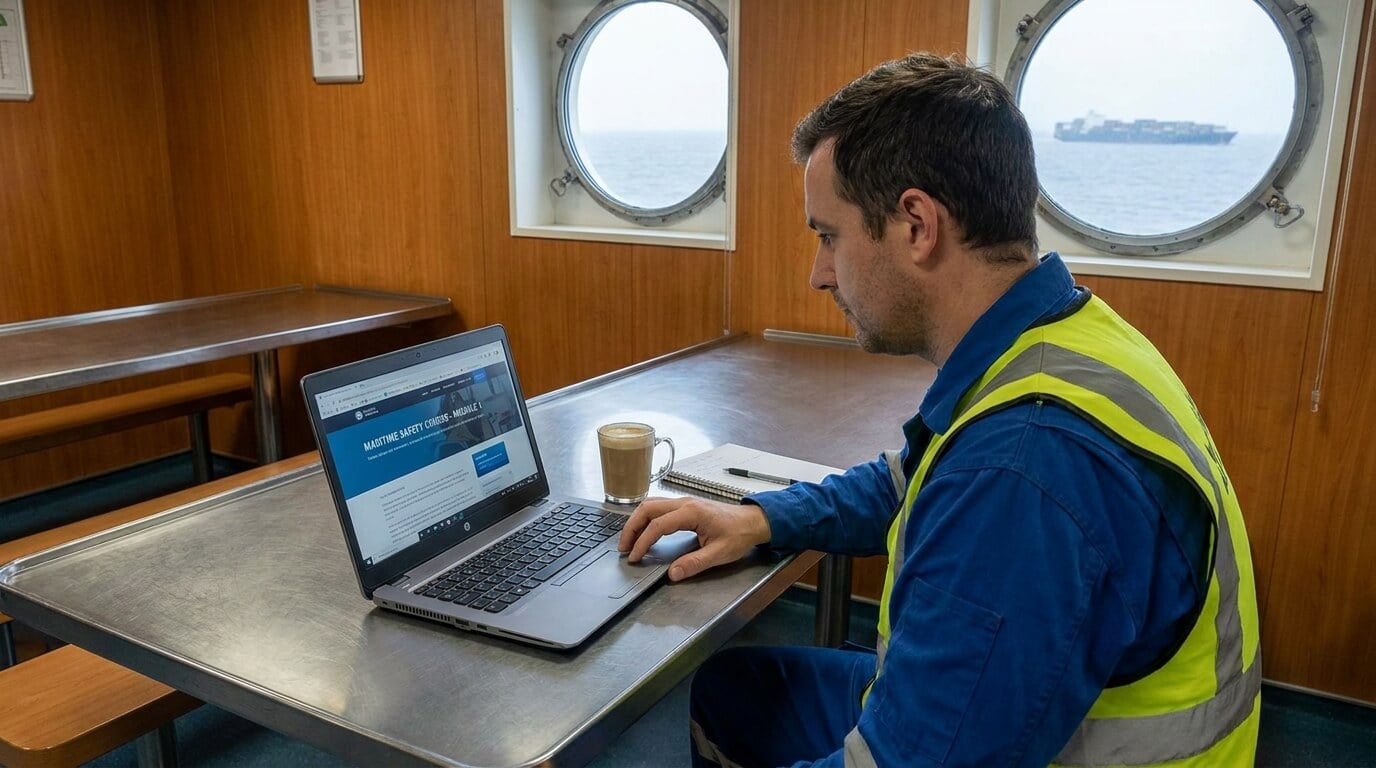
Maritime Just Transition Task Force: 8 Things Every Seafarer Needs to Know
Our take

The establishment of the Maritime Just Transition Task Force signifies a pivotal moment for seafarers, as it introduces essential changes that will shape the future of maritime careers. In a rapidly evolving industry, particularly in light of global climate initiatives and technological advancements, understanding these changes is crucial for every seafarer. The task force aims to ensure that transitioning to a more sustainable maritime sector is equitable and just, considering the impact on training, safety, and the Standards of Training, Certification, and Watchkeeping for Seafarers (STCW). As we delve into the implications of this initiative, it is essential to contextualize it within the broader maritime landscape, where issues of ecological sustainability are increasingly intertwined with maritime operations.
The task force's recommendations are timely, especially as the maritime industry faces pressure to reduce greenhouse gas emissions and enhance safety protocols. As discussed in articles like Transcriptomic response of Acropora cervicornis following transplantation to a marginal, nearshore environment, the urgency of addressing environmental challenges is echoed in the maritime sector. This transition does not come without challenges; it necessitates a re-evaluation of existing training systems and safety standards to align with new environmental and operational demands. For instance, the integration of digital technologies into maritime operations, which is covered in the article How reliable is Electronic Bottom Tracking in deep or rough sea conditions?, will require seafarers to upskill and adapt to innovative solutions that enhance operational efficiency and safety.
Furthermore, the implications of the Maritime Just Transition Task Force extend beyond immediate operational changes. As the maritime industry grapples with the dual challenges of meeting international climate commitments and ensuring the welfare of its workforce, the task force’s approach emphasizes the importance of inclusive dialogue among stakeholders. This collaborative spirit is crucial in fostering a sense of shared responsibility among industry players, policymakers, and seafarers alike. The focus on equitable training and safety measures ensures that all seafarers, regardless of their background or level of experience, have the opportunity to thrive in a transitioning industry.
Looking ahead, the developments initiated by the Maritime Just Transition Task Force raise essential questions regarding the future of maritime workforce dynamics. Will the proposed changes lead to a more skilled, adaptable, and resilient workforce, or will they inadvertently create barriers for those unable to keep pace with rapid technological advancements? As the maritime sector progresses toward sustainability, it is imperative to monitor how these initiatives unfold and what support mechanisms will be put in place to ensure that no seafarer is left behind. The commitment to a just transition not only reflects an understanding of the environmental imperatives but also highlights the socio-economic dimensions of maritime work, setting a precedent for other industries facing similar challenges.
In conclusion, the Maritime Just Transition Task Force represents a significant step towards a sustainable future for the maritime sector, with far-reaching implications for seafarers' careers. As the industry navigates this transformative phase, the focus must remain on fostering collaboration, ensuring equitable access to training, and maintaining safety standards. The journey ahead will undoubtedly be complex, but it is one filled with opportunities for innovation and growth, ultimately contributing to a healthier ocean and a more resilient maritime community.

Up to 800,000 seafarers could be unable to legally operate the ships they currently crew without further training by the mid-2030s. The vessels are already being ordered – methanol dual-fuel carriers, ammonia-powered bulk carriers, hydrogen demonstration ships – and so are the regulations. The Maritime Just Transition Task Force (MJTTF) was created for exactly this reason – to ensure that transition does not happen to seafarers, but with them.
Most seafarers do not know about it.
Established at COP26 in Glasgow in November 2021, the MJTTF is the first global sectoral body focused entirely on protecting workers in the transition of shipping to zero-carbon fuels. It has published training frameworks, shaped STCW revision and secured legal protections for workers within IMO’s own revised climate strategy.
Here are eight things seafarers need to understand about its work – and what that work requires of them.
1. What Is the Maritime Just Transition Task Force?

The Maritime Just Transition Task Force is a multi-institutional body created at COP26 in Glasgow in November 2021. It was launched jointly by the International Chamber of Shipping (ICS), the International Transport Workers’ Federation (ITF) and the United Nations Global Compact, with the International Maritime Organization (IMO) and the International Labour Organization (ILO) as partners.
It is the world’s first global sectoral task force of this kind that is dedicated to a “just transition.”
The ILO defines that term as “greening the economy in a way that is as fair and inclusive as possible to everyone concerned, creating decent work opportunities and leaving no one behind.”
When applied to maritime, that means shipping’s decarbonisation cannot be seen as a purely engineering problem to be solved in the shipyard — it is also a workforce problem that must be solved before crew are put aboard those ships.
2. Why 800,000 Seafarers Are At The Heart Of This Transition

In 2022 the MJTTF commissioned DNV to model the number of seafarers who would need new skills under different decarbonisation pathways. The results were consistent across all three modelled scenarios.
For the lowest ambition scenario, consistent with IMO’s interim target of a 50% cut in greenhouse gas emissions by 2050, around 300,000 seafarers need training on new fuels and technologies.
On the mid-range pathway, 450,000 seafarers must be trained in 2030 alone. Under the most optimistic full-decarbonisation scenario, as many as 800,000 seafarers need to be retrained by the mid-2030s.
Because of the current baseline, those numbers are more urgent now. A peer-reviewed survey in Frontiers in Marine Science (2026) found that more than 75% of respondents had no practical experience with LNG, batteries or synthetic fuels.
Almost 87% of the seafarers surveyed say they require partial or full training on ammonia, methanol and hydrogen.
The global merchant seafarer workforce is approximately 1.9 million as of January 2025 (UNCTAD).
The industry cannot retrain as many as 800,000 of them ad hoc, vessel by vessel, without a coordinated global framework, which is why the MJTTF exists.
3. Training Frameworks September 2025 Released

The MJTTF released the industry’s first structured training frameworks for seafarers working on vessels powered by ammonia, methanol and hydrogen on 17 September 2025. These are the first documents of their kind – available to the public, covering both entry level operational seafarers and senior officers, and supported by full instructor handbooks.
The publication contained several documents:
• Basic Training Framework and Instructor Handbook – a single resource covering all three fuels
• Advanced Training Frameworks and Instructor Handbooks (one per fuel – ammonia, methanol, hydrogen)
• Guidelines for developing Familiarisation Programmes for seafarers and shore-based personnel not covered by the STCW Convention
Lloyd’s Register Maritime Decarbonisation Hub was the technical lead and World Maritime University was the academic lead. The project was jointly funded by the IMO Technical Cooperation Programme and the Lloyd’s Register Foundation .
These frameworks serve as a basis for designing curricula and simulation-based assessments for maritime education and training (MET) institutions. For shipping companies, they provide a basis for updating safety management systems and crew on-boarding procedures on alternative-fuel vessels. All documents are publicly available for free at mjttf.org.
4. How This Work Is Transforming STCW

The STCW Convention, the International Convention on Standards of Training, Certification and Watchkeeping for Seafarers of 1978, sets the minimum worldwide requirements for the certification of seafarers. The MJTTF’s work is directly contributing to a comprehensive review of the regulation currently underway at the IMO.
The MJTTF presented its November 2024 training assessment report to the IMO Sub-Committee on Human Element, Training and Watchkeeping (HTW). Drawing on 12 hybrid workshops with 116 expert participants, the report details the specific competency and training needs for ammonia, methanol and hydrogen operations. IMO HTW approved draft generic training guidelines for all three fuels in February 2025. The guidelines were formally approved by the Maritime Safety Committee in June 2025.
| Milestone | Date |
|---|---|
| MJTTF training assessment report submitted to IMO HTW | November 2024 |
| IMO HTW approves draft generic training guidelines | February 2025 |
| Maritime Safety Committee formal approval | June 2025 |
| MJTTF interim training frameworks released | September 2025 |
| Next IMO HTW meeting — further progress expected | February 2026 |
The practical implication is near-term and concrete: the certification landscape for alternative fuel vessels is being written today. Seafarers who wait until mandatory STCW amendments are issued before seeking training will face a compressed timeline. Those who interact with the MJTTF frameworks early are ahead of the regulatory deadlines, not behind.
5. Safety Risks of Alternative Fuels That Seafarers Should Be Aware Of

The energy transition has led to fuel hazards that are very different from traditional HFO or diesel operations. In a survey of 527 seafarers, around 42% said that they consider alternative fuels to be a greater safety risk than the fuels they currently use. The data confirms that concern – but also shows that training can bridge the gap.
“Ammonia is highly toxic. The immediately dangerous to life or health (IDLH) concentration is 300 parts per million, a concentration that can be reached quickly in an enclosed space during a leak. Methanol burns with an almost invisible flame, which makes fire detection and suppression fundamentally different from hydrocarbon fire response.
Hydrogen’s flammability range is 4% to 75% in air — the widest of any commercial marine fuel — and it can embrittle certain metal alloys over time.
In addition to physical dangers, 32.8% of the seafarers surveyed were concerned about criminal penalties for unintentionally violating overlapping environmental regulations in different jurisdictions.
On an alternative-fuel vessel, the regulatory exposure goes up: more monitoring instruments, more emissions reporting requirements, more flag-state and port-state interactions around the fuel compliance data.
These specific risks are addressed in the MJTTF’s training frameworks by dedicated sections on fuel properties, emergency response procedures and safety management system integration. A seafarer boarding an alternative-fuel vessel without this fundamental knowledge carries a load the frameworks were designed to remove.
6. What the 10-Point Action Plan Looks Like in Practice

At COP27 in November 2022, the MJTTF released its position paper Mapping a Maritime Just Transition for Seafarers, containing a 10-point action plan for international organisations, industry, workers and academia.
The ten points are as follows:
1. Global training standards – Set consistent competency benchmarks for every flag state
2. Skill monitoring systems – track what competencies seafarers have and what training providers offer
3. Reskilling investment – fund workforce training for handling alternative fuels, with priority for developing nations
4. Health and safety first — make sure any new technologies are safe before putting crew on them
5. National maritime skills advisory councils are tripartite bodies that bring together government, shipowners and seafarer unions.
6. Recruitment and retention – overcome the growing exodus of experienced seafarers from the industry
7. ILO labour standards compliance — ensure the transition doesn’t erode Maritime Labour Convention (MLC) protections
8. Lifelong learning frameworks — career development pathways for crew at all levels
9. Inclusive transition — target resources to seafarers and seafaring nations most likely to be left behind
10. Human-centred approach — integrate worker wellbeing as a non-negotiable design principle in decarbonisation policy
Concrete implementation detail was added to point five in a September 2025 MJTTF report that provided governments with practical blueprints for establishing tripartite national advisory bodies. Seafarer unions have a formal, structured seat in national training and certification policy — not just an informal consultation role — where these bodies function.
7. Green Jobs Opportunity for Seafarers Not To Be Missed

The transition is not solely a risk story. Research by the Global Maritime Forum shows that decarbonising shipping could create as many as four million cumulative jobs in the energy supply chain by 2050, almost double the size of today’s global merchant seafarer workforce of 1.9 million.
Most of these positions are shore-side and will mainly arise in the 2030s: alternative fuel assessment, management of shore power infrastructure, emissions compliance, green corridor coordination and fuel safety verification. Many of these jobs require exactly the operational knowledge that experienced seafarers already have.
The MJTTF has developed mobility frameworks specifically designed to help seafarers develop transferable skills during their sea service — positioning them for land-based careers as shipping’s operational profile evolves. Lloyd’s Register’s December 2025 analysis has confirmed that traditional shipboard roles are already beginning to extend into shore-based positions in emissions compliance and fuel assessment.
The data on safety is also directionally positive. Today, seafaring accounts for 50 to 100 deaths per 100,000 workers – among the highest death rates of any profession. In time, you can expect that number to drop with regulated, well-trained operations on next-generation fuel systems. In this context a just transition means better career prospects and structurally safer ships.
8. What Seafarers Should Do Now

MJTTF training frameworks published in September 2025 are free and publicly available at mjttf.org. Seafarers can download the Basic Training Framework covering all three alternative fuels, along with advanced per-fuel documents and instructor handbooks, at no cost and without institutional enrolment.
Practical steps for seafarers:
• Review the Basic Training Framework for the fuel types most relevant to their vessel sector or career path
• Ask their employer if the company’s safety management system has been updated to incorporate MJTTF familiarisation programme guidance
• Contact their ITF-affiliated union about representation on national-level tripartite advisory bodies — the September 2025 MJTTF report on this subject is available at mjttf.org and is directly actionable
• Use the February 2026 IMO HTW meeting as a milestone: the output will inform the next generation of mandatory training standards
• Contact training institutions directly to see if operations with ammonia, methanol and hydrogen are included in current course syllabi
The size of the gap is not theoretical: 64% of seafarers in the Eastern Mediterranean had received no decarbonisation training whatsoever in the two years prior to 2025. An extra 27% of those who received training said it was not enough. Today’s seafarers who turn to the MJTTF’s public offerings are neither leading the pack nor lagging behind it; they are simply not lagging behind.
Summary
The Maritime Just Transition Task Force was built on a premise—that the people who are going to work on green ships do not yet have the training, legal protections, or institutional representation to do so safely and fairly. In less than four years, it has launched industry-first training frameworks, informed STCW revision and embedded worker protection language into IMO’s revised GHG Reduction Strategy itself.
Whether those protections extend to individual seafarers depends entirely on whether seafarers know they exist. ” The frameworks are open. The advisory structures are under development. The STCW changes are coming anyway. The only question is if any given seafarer is prepared.
Conclusion
The Maritime Just Transition Task Force coordinates global efforts to ensure that shipping’s decarbonisation does not harm seafarers. It develops training frameworks for alternative fuels, pushes for the reform of STCW, publishes research on the skills needs of seafarers and works with governments to set up national advisory bodies that provide seafarers with formal representation in policy decisions.
FAQs
How many seafarers will require training on alternative fuels?
DNV undertook a study on behalf of the MJTTF that modelled three scenarios. Some 300,000 seafarers need to be trained under the pathway of lowest ambition. Under the mid-range pathway, 450,000 need to be trained by 2030. In the most ambitious full decarbonisation scenario, up to 800,000 seafarers will need additional training by the mid-2030s.
Are the MJTTF training frameworks compulsory?
No – the September 2025 frameworks are not currently mandatory. These are interim industry guidance issued pending formal STCW amendments. However, they are also directly contributing to the ongoing comprehensive STCW review. IMO HTW approved draft generic guidelines based on this work in February 2025 and formal MSC approval in June 2025. As the STCW revision continues through the HTW process, mandatory certification requirements are expected to follow.
What fuels are included in the new seafarer training frameworks?
The frameworks include ammonia, methanol & hydrogen as marine fuels. A simple combined framework is available for all three fuels while advanced frameworks are available for each fuel individually. Exist separate familiarisation guidelines for seafarers and shore-based personnel not covered by the STCW certification requirements but who will be working with alternative-fuel operations.
What will the Maritime Just Transition Task Force mean for STCW?
The MJTTF’s research and training frameworks have been formally presented to IMO’s Sub-Committee on Human Element, Training and Watchkeeping. HTW approved draft generic training guidelines for alternative fuels in February 2025. Those guidelines were formally approved by the Maritime Safety Committee in June 2025. The HTW meeting in February 2026 will advance the development of mandatory training standards under the STCW.
Seafarers can access MJTTF resources through the following means:
All MJTTF publications — training frameworks, instructor handbooks, the 10-point action plan position paper and the report on setting up national advisory bodies — are freely available at mjttf.org/Reports-and-Resources. No subscription or institutional affiliation required.
Reference:
– IMO — Maritime Just Transition: https://www.imo.org/en/OurWork/HumanElement/Pages/Maritime-Just-Transition.aspx
– MJTTF Official Site: https://www.mjttf.org/
– ICS — MJTTF Training Frameworks Press Release: https://www.ics-shipping.org/press-release/maritime-just-transition-task-force-launches-first-interim-seafarer-training-frameworks-for-the-use-of-ammonia-methanol-and-hydrogen-as-fuel/
– ITF Seafarers — Training Frameworks: https://www.itfseafarers.org/en/news/maritime-just-transition-task-force-launches-first-interim-seafarer-training-frameworks-use
– ITF Global — 10-Point Action Plan: https://www.itfglobal.org/en/resources/task-force-10-point-action-plan-achieve-just-transition-seafarers
– Lloyd’s Register Foundation — MJTTF: https://www.lrfoundation.org.uk/programmes/the-maritime-just-transition-taskforce
– Nautilus International — COP27 Action Plan: https://www.nautilusint.org/en/news-insight/news/action-plan-for-a-just-transition-to-green-shipping-launched-at-cop27/
– UN Global Compact — Set Sail for Zero: https://unglobalcompact.org/take-action/think-labs/just-transition/about
– World Maritime University — MJTTF Training Frameworks: https://www.wmu.se/news/mjttf-seafarer-training-ammonia-methanol-hydrogen
Read on the original site
Open the publisher's page for the full experience