water temperature
World Data Ocean keeps water temperature in one place: 7 stories so far. The section currently leads with “A solitary shark in a Busan canal raises urgent questions about human-made barriers”, “Shamal Winds Reveal the Physical Drivers of Arabian Gulf Mixing”, and “Satellite and field data merge to track harmful blooms in El-Mex Bay”. A solitary dusky shark has spent three weeks refusing to leave a man-made canal in Busan, and no one can explain why. Cold, dry Shamal winds do more than chill the air; they reach down and stir the entire water column. A Global Hub for Ocean Intelligence 4 World Data Ocean is a centralized digital platform where researchers, scientists, and ocean enthusiasts converge to… The list below is every water temperature story on World Data Ocean, newest first.
A solitary shark in a Busan canal raises urgent questions about human-made barriers
A solitary dusky shark has spent three weeks refusing to leave a man-made canal in Busan, and no one can explain why. Bukang-i, as locals call her, has twice evaded rescue attempts, even swimming over a net to return. Her refusal to feed and a strange organ protrusion raise urgent questions about human-made barriers in coastal environments. *Shamal Winds Reveal the Physical Drivers of Arabian Gulf Mixing* similarly shows how understanding physical forces is essential for marine stewardship.

Shamal Winds Reveal the Physical Drivers of Arabian Gulf Mixing
Cold, dry Shamal winds do more than chill the air; they reach down and stir the entire water column. New research from the northwestern Arabian Gulf shows that these winter events drive convective mixing all the way to the seabed, fundamentally reshaping turbulence in this shallow basin. The study's model, observation comparisons reveal a critical insight: tidal shear dominates under calm conditions, but Shamal peaks override that mechanism, homogenizing the water column and suppressing shear-driven mixing.
Satellite and field data merge to track harmful blooms in El-Mex Bay
In August, Sentinel-2 pixels in El-Mex Bay lit up with red tide signals, marking the season's most intense bloom. The study's strength lies in pairing RTI and NDCI spectral indices with field data to confirm what drove the summer succession: warm water and nutrient pulses favored *Prorocentrum cordatum* and *Heterosigma akashiwo*. That integrated approach turns satellite imagery into a practical early-warning tool. For readers tracking broader monitoring efforts, our related piece on citizen science offers a complementary view of closing coastal observation gaps.
Wave-Powered Upwelling Boosts Kelp Growth in Gulf of Maine Study
In the Gulf of Maine, wave-powered upwelling could turn the tide for kelp aquaculture. A coupled modeling study, grounded in multiyear empirical data, finds that this approach can cool surface waters by an average of 1.0 °C and boost nitrate concentrations from June through September. The result? A potential yield increase of nearly 10 percent. This is pragmatic ocean intelligence: working with natural physical processes to address nutrient limitation and seasonal warmth.
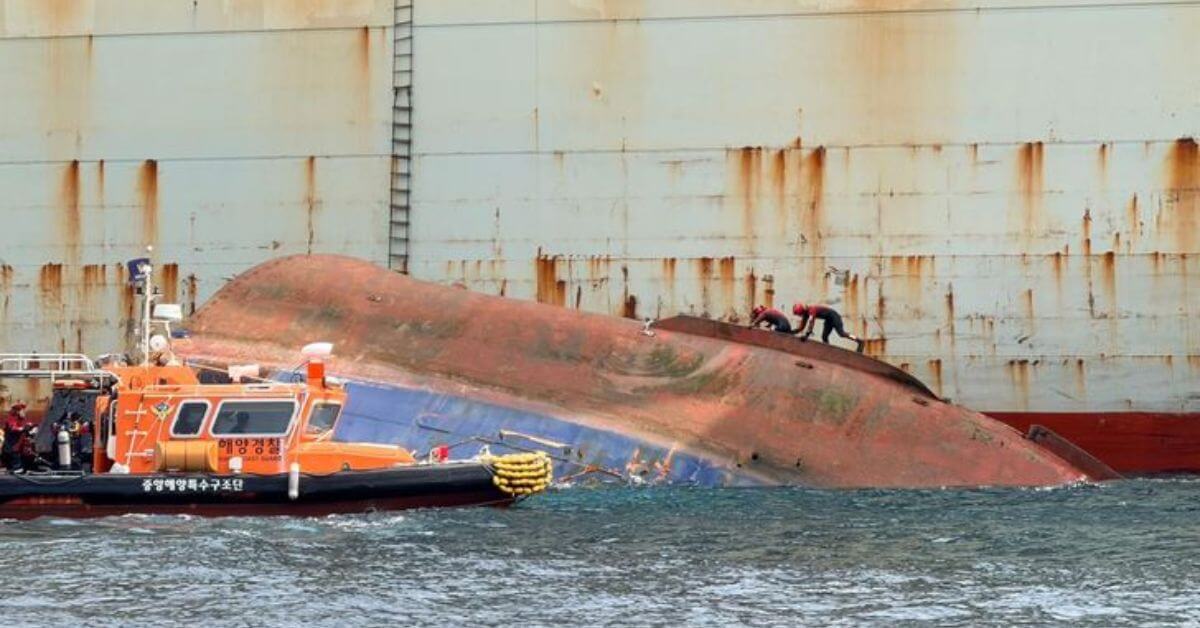
Tugboat Sinking Near Busan: Search Underway for Six Missing Crew.
A 286-tonne tugboat capsized and sank east of Oryukdo Island, leaving six crew members missing. The TNS Catcher went down at roughly 1:29 p.m., fully disappearing beneath the surface by 3:27 p.m. Search operations are underway, and every minute matters in these waters. Maritime emergencies like this remind us how quickly conditions can turn. For broader context on recent incidents, our coverage of the cargo ship fire near Mykonos offers a similar case of rapid response.

Deep Ocean Warming: Longitudinal Data Reveals a Concerning Trend.
The ocean's abyss was long considered a stable, slow-motion frontier, but new longitudinal data now shows the deepest layers are warming. This is not a distant anomaly; it is a measurable shift in a system we rely on for climate stability. We find this trend deeply concerning, yet it reinforces why sustained observation matters. As we track these changes, we must connect them to broader disruptions, much like our recent analysis of Atlantic Circulation Weakens, to fully grasp the scale of what is unfolding.
Mediterranean Sea: Shifting Ocean Conditions Reshape Velella velella Distribution
Velella velella, the violet sail-by-the-wind sailor, is no stranger to the Mediterranean, but the conditions steering its course are changing. As surface temperatures and wind patterns shift, we are seeing a species whose distribution is a direct, measurable response to the ocean's evolving state. This is not a spectacle, but a signal. Understanding these movements helps us calibrate our own ocean intelligence, much like the data discovery efforts highlighted in our related coverage.