regulatory compliance
7 stories filed under regulatory compliance on World Data Ocean. The newest of them: “AI and digitalisation anchor new maritime safety and emissions pact”, “Advancing Sustainable Shipping: Ethanol-Fuelled Tanker Project Gains Momentum”, and “Integrated Ocean Data: Enabling Sustainable Marine Resource Management.”. A new memorandum of understanding between China Merchants Energy Shipping and RINA anchors maritime safety and emissions management in digitalisation and AI. A 50,000 dwt ethanol-fuelled MR tanker is moving from concept toward classification, with K Shipbuilding and Lloyd's Register now assessing feasibility ahead of an AiP. A Global Hub for Ocean Intelligence 4 World Data Ocean is a centralized digital platform where researchers, scientists, and ocean enthusiasts converge to… The list below is every regulatory compliance story on World Data Ocean, newest first.

AI and digitalisation anchor new maritime safety and emissions pact
A new memorandum of understanding between China Merchants Energy Shipping and RINA anchors maritime safety and emissions management in digitalisation and AI. This is not speculative; it is an integrated data ecosystem designed for measurable, real-world impact. As the industry seeks validated pathways to decarbonisation, this collaboration aligns with efforts like the Wallenius Marine WinPrOVeDD project, which aims to harness wind energy more efficiently through empirical design validation.
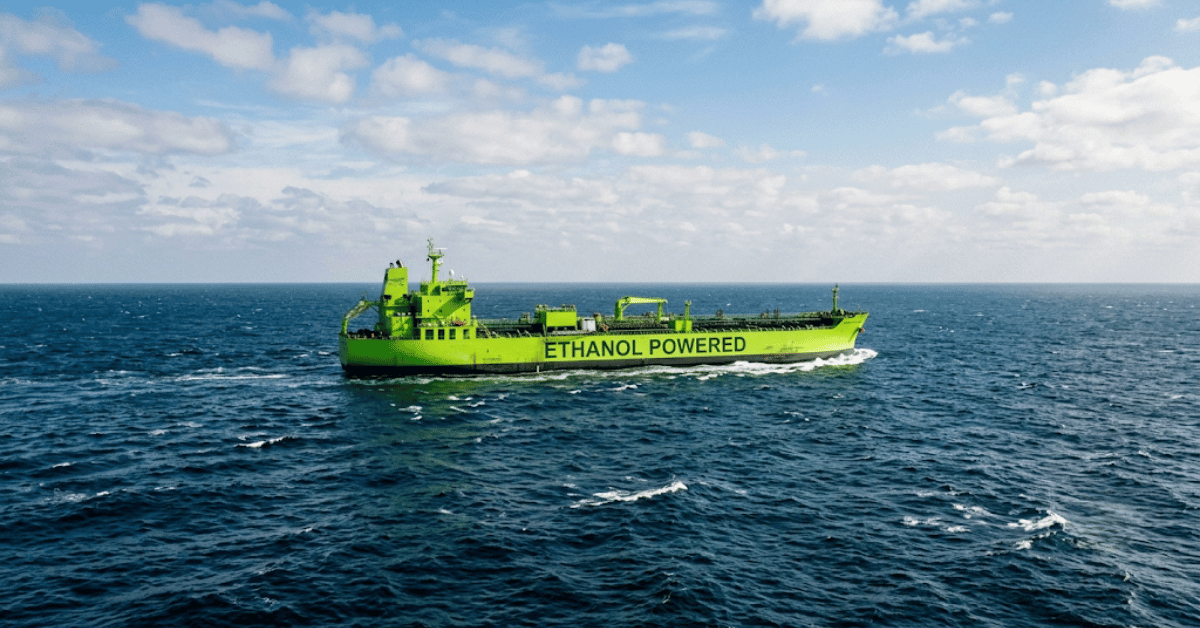
Advancing Sustainable Shipping: Ethanol-Fuelled Tanker Project Gains Momentum
A 50,000 dwt ethanol-fuelled MR tanker is moving from concept toward classification, with K Shipbuilding and Lloyd's Register now assessing feasibility ahead of an AiP. That is measured progress in a sector where fuel choice remains unsettled. Decarbonisation is not a single solution, and ethanol deserves scrutiny alongside LNG and ammonia. For context on alternative vessel design, our analysis of optimal LNG carrier capacity offers a useful comparison. We will follow this project's pathway to approval with interest.

Integrated Ocean Data: Enabling Sustainable Marine Resource Management.
Sustainable marine resource management has reached a critical juncture, where the convergence of economic activity and ecological pressure demands more than static models can offer. Our proposed framework answers this directly, integrating high-resolution ecological modeling with adaptive governance through the ECO STORM and AQUA GOV systems. This is computational intelligence applied where uncertainty is the rule, not the exception. For deeper context on how data flows across these same seascapes, our piece on integrated subsea cables offers a complementary view.
Somalia’s Fisheries: Governance Gaps Fuel IUU Fishing and Resource Depletion
Somalia's fisheries governance has unraveled since 1991, leaving its Exclusive Economic Zone exposed to foreign fleets operating without accountability. This systematic review confronts a hard truth: institutional fragmentation between Mogadishu and federal member states, weak surveillance, and corruption have rendered UNCLOS, the PSMA, and IOTC measures insufficient on their own. The paper argues convincingly that centralized enforcement and decentralized governance are mismatched tools. A hybrid model, blending state capacity with community co-management and technological monitoring, offers a more credible path forward.
Governing Marine Damage: An Evolutionary Analysis of Compensation Strategies in China
Compensation for marine ecological damage rarely follows a straight line. In China, the central government, local regulators, and sea-using enterprises each pursue distinct interests, often turning policy into a delicate balancing act. This study's evolutionary game model reveals that penalties must be differentiated to drive compliance, while monetary standards require careful calibration, too low fails, too high backfires. The choice between cash and restoration hinges on cost. For deeper context on governance challenges, see our analysis of Somalia's Fisheries. Governance shapes outcomes, measurably and persistently.

Accelerating Maritime Transition: Marine Insight and Azolla Partner for Ocean Intelligence.
Decarbonization demands more than ambition; it demands coordinated action. Marine Insight and Azolla have formed a strategic alliance to accelerate the maritime transition, pairing Marine Insight's global reach with Azolla's technical depth in vessel performance and regulatory compliance. This partnership is a practical step toward measurable progress. For those tracking the regulatory side of this shift, our related piece on validating onboard emissions data for LNG shipping offers a useful parallel. The transition is complex, but integrated data ecosystems make it navigable.

Maritime Workforce: Data Reveals Challenges and Opportunities for Women Seafarers
One percent. That is the share of the global maritime workforce made up of female seafarers, a figure that underscores how far the industry still has to go. The data on crew training, retention, and recruitment points to systemic hurdles, not a lack of capable candidates. Addressing this imbalance is a measurable step toward strengthening ocean intelligence and operational resilience. For a broader view of how the sector is evolving, our coverage of the Navy's autonomous systems integration offers useful context.