ocean monitoring
World Data Ocean keeps ocean monitoring in one place: 11 stories so far. The section currently leads with “Measuring the Ocean's Warming Pulse at 2,000 Meters”, “From surface to seafloor, a calibrated global map of microplastic drift”, and “From orbit to ocean floor: integrating observations for Earth system predictions”. Two thousand meters down, the ocean is warming measurably and without pause. From surface to seafloor, this calibrated global map of microplastic drift transforms scattered data into measurable ocean intelligence. A Global Hub for Ocean Intelligence 4 World Data Ocean is a centralized digital platform where researchers, scientists, and ocean enthusiasts converge to… The list below is every ocean monitoring story on World Data Ocean, newest first.
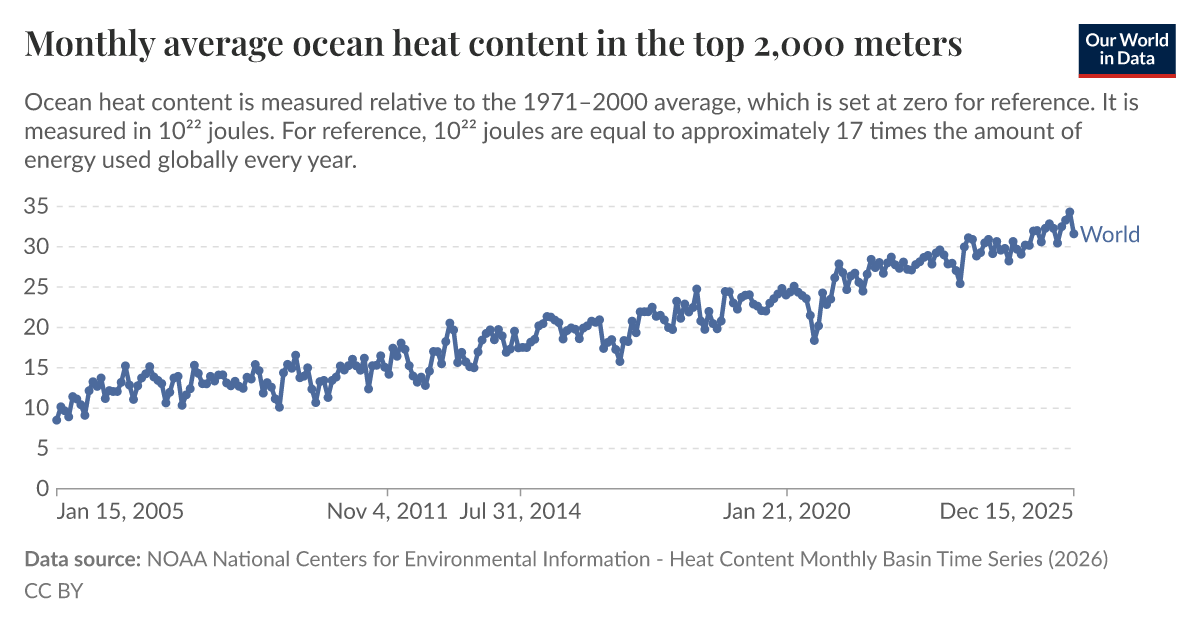
Measuring the Ocean's Warming Pulse at 2,000 Meters
Two thousand meters down, the ocean is warming measurably and without pause. Monthly average heat content in the top 2,000 meters provides one of the most empirically grounded climate indicators available, validated, peer-reviewed, and increasingly urgent. This isn't a distant signal; it is a calibrated pulse we can track in real time. Understanding drives protection. For deeper context on how global experts are building the data framework to monitor these changes, see "Global experts unite to steer Ocean Decade's data and knowledge framework."

From surface to seafloor, a calibrated global map of microplastic drift
From surface to seafloor, this calibrated global map of microplastic drift transforms scattered data into measurable ocean intelligence. It is empirical, peer-reviewed, and urgently needed. Understanding where plastics accumulate, and where they travel, is the first step toward action. For deeper context on the sources feeding this crisis, see our related coverage of how more than 1,000 rivers drive 80% of ocean plastic emissions. Protection begins with precision.
From orbit to ocean floor: integrating observations for Earth system predictions
A satellite sees the ocean's surface; a drifting buoy feels its depths. The Global Ocean Observing System, convened by the World Meteorological Organization, now integrates these vantage points into a single, calibrated data ecosystem. This is not abstract science. It is the foundation for Earth system predictions that shape climate resilience and maritime safety. For deeper context, our related coverage on ocean stewardship explores how this data refines our responsibility to the sea.

Integrated data ecosystems sharpen Copernicus ocean monitoring
Integrated data ecosystems sharpen Copernicus ocean monitoring by transforming raw observations into validated, measurable insights. The SEAMLESS Project delivers a calibrated, integrated data ecosystem that turns fragmented signals into coherent ocean intelligence. This is not about more data, it's about better data, peer-reviewed and ready for real-time action. Understanding drives protection. For deeper coverage, our related article on calibrating ocean intelligence for a sustainable data ecosystem explores the hidden challenges behind this progress.
Calibrating our ocean intelligence for a sustainable data ecosystem
Every ocean dataset carries a hidden cost: the energy, materials, and infrastructure required to collect, store, and process it. Unchecked data growth risks undermining the very sustainability we seek to measure. Calibrating our ocean intelligence means building an integrated data ecosystem where every byte is validated, measurable, and purpose-driven. We must treat data stewardship as seriously as ocean stewardship. For deeper context, our coverage of "From orbit to ocean floor" examines how integrated observations strengthen Earth system predictions without expanding our footprint.
Eleven data-driven innovations sharpen our ocean intelligence
Eleven measurable innovations are sharpening our ocean intelligence. From validated carbon tracking systems to data-driven models revealing how the atmosphere forces ocean dynamics, each tool adds a calibrated layer to our understanding. These are not abstract concepts, they are empirical, peer-reviewed advances that make ocean stewardship actionable. The Ocean Carbon and Acidification Data System in *Nature* exemplifies this: validated data powering a measurable path forward. Understanding drives protection. From orbit to ocean floor, the evidence is building.

Ocean data expands from measured depths to validated insights
From orbit to ocean floor, the National Centers for Environmental Information (NCEI) transforms measured depths into validated, peer-reviewed insights. This expanding ocean of data is our most calibrated window into planetary change. Understanding drives protection. For deeper context on how these long-term records reveal accelerating shifts, see our related analysis, "Decades of Atlantic circulation data reveal measurable climate indicators." The empirical story is clear: what we measure, we can protect.

Integrated Monitoring Supports Ocean Resilience in Developing Economies
Ocean observation should not be a luxury of wealth. In developing economies, where monitoring gaps align with the highest climate exposure, this co-developed framework proves otherwise. By centering on user needs and open satellite data, it builds capacity without waiting for dense in-situ arrays. The South African OCIMS tool shows how integrated systems accelerate readiness. This is the practical path to resilience. For more on expanding observational reach, see our related coverage, "Bridging Data Gaps: Integrating Citizen Science for Ocean Intelligence."

Integrated Ocean Intelligence: EU’s OceanEye Initiative Advances Real-Time Data.
The EU's OceanEye initiative is turning real-time ocean observation into a shared, measurable asset. By integrating data from orbit to sea floor, it gives researchers and policymakers a clearer, peer-reviewed picture of climate indicators as they shift. That kind of empirical clarity is what effective stewardship demands. For context on how marine data travels, our coverage of integrated subsea cables across the Indian Ocean pairs well with this story. Ocean intelligence works best when the whole system is connected.
Ocean Carbon Data Expands, Driving Climate Insights and Stewardship.
Newly released SOCAT and GLODAP datasets give researchers a sharper read on ocean carbon, and that clarity matters. NOAA's latest update strengthens our ability to track climate indicators with empirical rigor, turning scattered observations into an integrated data ecosystem. This is ocean intelligence in action: measured, validated, and ready to inform stewardship. For those exploring how such calibrated data flows into broader discovery efforts, our related piece on integrated data discovery offers a useful next step. The science is solid, and the timing feels right.
Long-Term Ocean Acidification Trends Revealed at Station ALOHA
Forty years of pH data from Station ALOHA now show a clear pattern: the ocean's surface is acidifying, and the trend is not only persistent but intensifying. Using fractional integration methods, this study confirms a statistically significant decline in both raw and logged pH series from 1985 to 2024. The key insight is long memory; shocks to pH have lasting effects. Recursive estimates reveal that both persistence and the negative trend have strengthened over time.