microbial communities
microbial communities at World Data Ocean is a file of 4 stories. The newest of them: “Microbe-mineral interactions unlock rapid Baltic Sea nodule growth”, “Mapping Viral Drivers of Life in Earth's Deep-Sea Chemical Oases”, and “Microbial communities may drive invasive seagrass growth in mixed meadows”. In the eastern Gulf of Finland, ferromanganese nodules grow up to three orders of magnitude faster than their deep-sea counterparts. Deep within the ocean, hydrothermal vents create chemically driven oases where life thrives without sunlight. A Global Hub for Ocean Intelligence 4 World Data Ocean is a centralized digital platform where researchers, scientists, and ocean enthusiasts converge to… The list below is every microbial communities story on World Data Ocean, newest first.

Microbe-mineral interactions unlock rapid Baltic Sea nodule growth
In the eastern Gulf of Finland, ferromanganese nodules grow up to three orders of magnitude faster than their deep-sea counterparts. Our integrated analysis reveals that microbial communities are not passive inhabitants but active drivers of this rapid formation. Mn-rich nodules host distinct Mn-oxidizing prokaryotes, while Fe-rich nodules favor EET-capable phylotypes. This positions Baltic nodules as a critical reference for understanding ore genesis on human timescales. For broader maritime context, see our coverage of the EUROGUARD vessel launched to safeguard Baltic Sea cables.
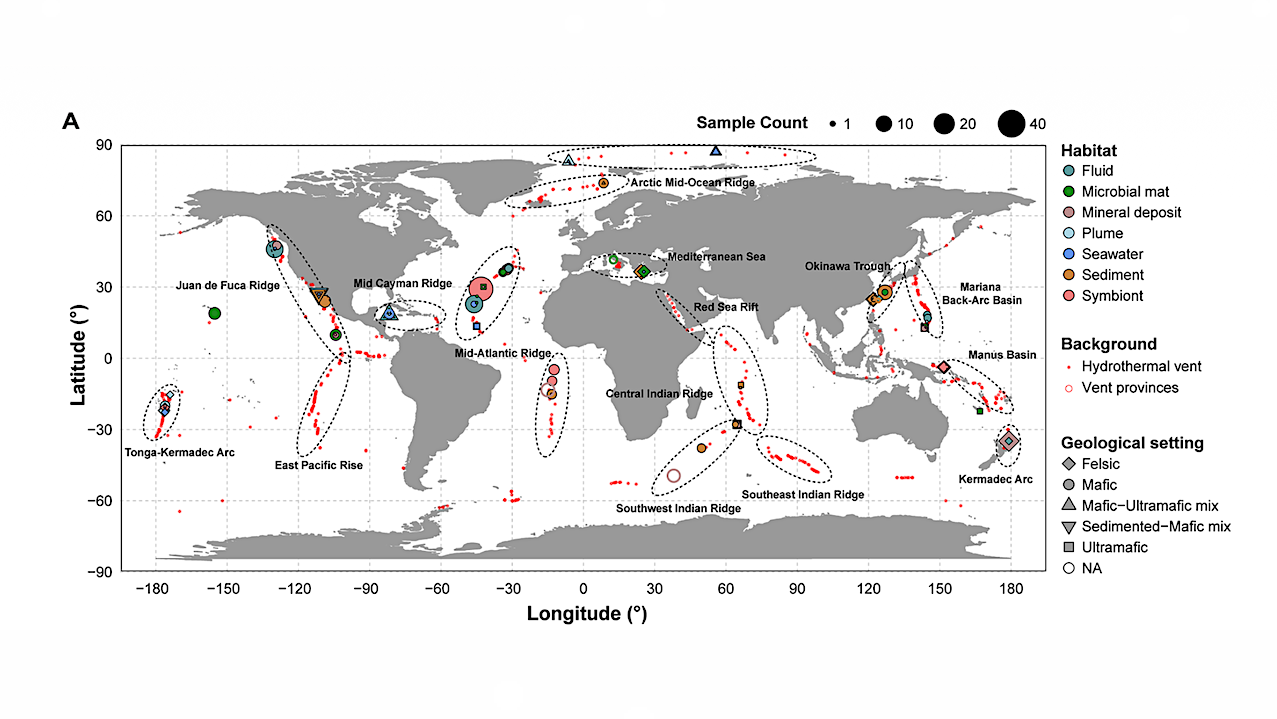
Mapping Viral Drivers of Life in Earth's Deep-Sea Chemical Oases
Deep within the ocean, hydrothermal vents create chemically driven oases where life thrives without sunlight. A new study maps the viral drivers shaping these extreme ecosystems, revealing a hidden layer of biological control. Understanding these microbial interactions is essential for grasping how life persists under pressure. For context on how we track life across the ocean, see our related article, "New Whale Chart Brings Validated Migration Data to Ocean Data Platform."
Microbial communities may drive invasive seagrass growth in mixed meadows
Microbial communities may hold the key to why the invasive seagrass *Halophila stipulacea* thrives alongside native Mediterranean species like *Cymodocea nodosa*, while the native suffers. Our analysis of 16S rRNA genes reveals distinct bacterial assemblages: the native's microbiome shifts under stress, but the invader's bacterial diversity flourishes precisely in mixed environments, where its growth accelerates. This is not passive colonization; it suggests a competitive edge shaped by unseen allies. Understanding these microbial drivers is essential for predicting invasion dynamics.
Microbiome Manipulation Reveals Coral Health and Resilience Insights.
Coral health is not a fixed state but a dynamic balance, and a new study shows that manipulating the microbiome can tip that balance toward resilience. This research offers a measurable, peer-reviewed path forward for reef conservation, moving beyond observation to intervention. We see this as a vital step in building ocean intelligence, and it pairs well with our coverage in "Magma and microbial activity may rewrite a 2-billion-year-old carbon signal." Understanding these biological levers is how we turn insight into protection.