ecology
World Data Ocean keeps ecology in one place: 28 stories so far. The section currently leads with “AI Illuminates the Ocean's Hidden Data, From Surface to Seafloor”, “Phenological data confirms warming springs drive earlier cherry blossoms in Japan”, and “Where Artifacts Anchor Life: Maritime Archaeology Meets Reef Ecology”. From orbit to seafloor, the ocean holds more data than we can currently interpret. Japan's cherry blossoms are arriving earlier, and the evidence is clear: phenological data confirms that warming spring temperatures are driving this shift. A Global Hub for Ocean Intelligence 4 World Data Ocean is a centralized digital platform where researchers, scientists, and ocean enthusiasts converge to… The list below is every ecology story on World Data Ocean, newest first.

AI Illuminates the Ocean's Hidden Data, From Surface to Seafloor
From orbit to seafloor, the ocean holds more data than we can currently interpret. This review examines how artificial intelligence and machine learning are transforming our ability to analyze complex, unevenly sampled datasets across physical oceanography, ecology, and engineering. The findings are pragmatic: AI excels at predicting currents, reconstructing subsurface conditions, and classifying marine life. Yet the authors rightly caution that sparse observations and black-box models limit reliability.
Phenological data confirms warming springs drive earlier cherry blossoms in Japan
Japan's cherry blossoms are arriving earlier, and the evidence is clear: phenological data confirms that warming spring temperatures are driving this shift. This is not anecdotal, it's a measurable, empirical signal of climate change playing out in real time. Understanding these patterns is essential for predicting broader ecological impacts. For deeper context on how long-term data reveals structural change, see our related article, "A calibrated shift: global employment data confirms the rise of the service sector."
Where Artifacts Anchor Life: Maritime Archaeology Meets Reef Ecology
Where Artifacts Anchor Life asks a question many of us in the sciences have faced: whether to deepen expertise or broaden foundations. A maritime archaeology program with oceanography and marine biology electives is a validated, integrated path, not a detour. You already have empirical research experience and peer-reviewed work. That foundation is measurable. Adding targeted coursework in reef ecology will likely qualify you for further graduate study without starting over.
From Neurobiophysics to the Sea: Charting a Path to US Marine PhDs
A BSc in Neurobiophysics is not a barrier to a US marine biology PhD; it is a different kind of asset, one that brings a quantitative rigor many labs actively seek. Your background in electroporation and microfluidic systems is a strong signal of technical maturity, and programs increasingly value that over a standard biology checklist. For a direct path, target interdisciplinary labs where bioengineering meets ocean observation, as your skillset will be seen as an integration tool, not a shortfall.
Field-Bound Ecologist Maps a Career Path in Fisheries Observation
A degree in ecology and a minor in marine science can open doors to some of the most demanding field roles on the planet, and this graduate is aiming straight for the deck of a fisheries observer vessel. The decision to take a year between undergraduate study and graduate school is a sound one, especially when it involves collecting empirical data in Alaska's working waters.

Unexpected Chiton Discovery in Puerto Rico Challenges Species Distribution Models
A chiton thought to be a snakeskin species has surfaced in Puerto Rico, yet that species was never documented in Caribbean or Atlantic waters. The discovery challenges the reliability of species distribution models that underpin much of our ocean intelligence. This is not a minor range extension, it is a signal that empirical data must catch up with predictive frameworks. Understanding drives protection, and this finding reminds us that validated, real-world observation remains the anchor of credible marine science.
Exploring Plankton Science: Accessible Research for Curious Ocean Observers
A two-year fondness for plankton, sparked by picture books and a saved-for net, is exactly how meaningful ocean observation begins. This researcher's request for accessible depth, rather than just surface-level facts, reflects a genuine curiosity that we share. It is a reminder that scientific literacy grows through patient, specific questions. For those ready to move beyond identification guides, we recommend exploring related coverage on species distribution, such as the unexpected chiton discovery challenging current models, to see how amateur observations can align with empirical inquiry.
Bridging Disciplines: A Veteran's Pathway to Marine Biology Studies
A veteran of Army special operations is trading one form of service for another, aiming for a PhD in marine biology after a BA in history and government. The pivot is bold, but the foundation is solid, even if it feels otherwise. The GI Bill provides the runway, and Rosenstiel's shark research program offers a clear target. This is not a casual interest; it is a calculated transition.
Itajaí's $43M Waste Spend: Data Reveals Persistent Ocean Pollution
Itajaí has spent $43 million on waste management, yet the data shows persistent ocean pollution. That is a structural failure, not a funding gap. Dr. Laura Pioli Kremer and Arthur Rancatti laid it out plainly on local TV: urban runoff and coastal mismanagement are global issues, regardless of geography. The numbers demand we treat ocean literacy as infrastructure, not an afterthought. For deeper context on how monitoring gaps hide these problems, see our piece on integrating citizen science for ocean intelligence.
Stable Isotope Analysis Reveals Dietary Links in Ocean Food Webs
Stable isotope analysis is transforming how we trace the movement of energy through ocean food webs. By examining the chemical signatures embedded in marine life, researchers can now map dietary links with remarkable precision. This study validates that approach, offering measurable evidence of how species interconnect beneath the surface. The findings reinforce a simple truth: understanding these relationships is essential to protecting the systems that sustain them.
Human Impact Reveals Shifting Biogeochemical Patterns in Marine Ecosystems
Measured shifts in marine biogeochemical patterns now point to a clear conclusion: human activity is redefining ocean chemistry at scale. These are not abstract anomalies but calibrated signals, tracked through integrated data ecosystems and peer-reviewed observation. We see this as an opportunity to refine our understanding, not an excuse for alarm. The evidence demands rigorous attention and shared response. For those tracking how marine structures challenge assumptions, our related coverage, including the Port Phillip Bay debate, offers useful context.
Rising Porpoise Sounds Signal Baltic Sea Population Shift
Acoustic monitoring has detected a measurable rise in porpoise vocalizations across the Baltic, signaling a population shift we cannot ignore. These calibrated, real-time data points offer empirical evidence of changing marine behavior, a clear climate indicator demanding our attention. Understanding drives protection. For deeper context on how such ocean intelligence informs career pathways in marine science, see our related piece, "Navigating a Marine Studies BA: Pathways to a Marine Biology Career."
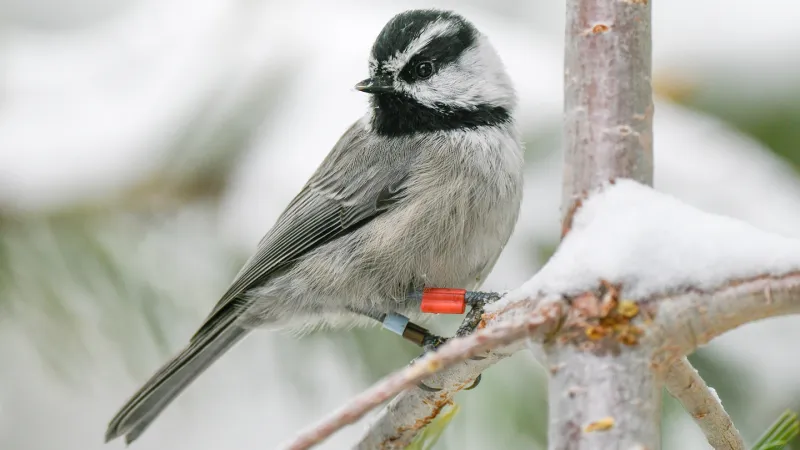
Cognitive Resilience: Smarter Chickadees Thrive Through Winter and Age.
A chickadee's cognitive edge persists into old age, and that resilience translates directly to survival and reproductive success. Wild birds with sharper problem-solving skills maintained their mental acuity through senescence, produced more offspring, and hosted healthier gut microbiomes. This is empirical evidence that intelligence is not merely a youthful advantage but a measurable, lifelong asset. Understanding drives protection. For deeper coverage on environmental intelligence, see our related report on "Cascadia and San Andreas: Evidence Suggests Sequential Earthquake Risk."
Arctic Glacier Retreat Creates New Coastal Lagoons, Expanding Ecosystems
Retreating glaciers across the Arctic are redrawing coastlines, and Svalbard now hosts a growing number of coastal lagoons where none existed before. These newly emerged paraglacial systems remain largely absent from regional monitoring, despite their rapid expansion. We see this as a missed opportunity: the lagoons form a developmental continuum, from glacier-influenced basins to biologically structured systems, and early evidence suggests they act as biogeochemical reactors, including potential methane sources.
Southeast Florida Waters Yield Unexpected Fish Species Observations.
Routine surveys off Southeast Florida were expected to confirm known species, yet these waters delivered observations that defy existing distribution models. The findings suggest our understanding of regional marine life remains incomplete, and that is precisely why sustained monitoring matters. Observations like these are not anomalies to dismiss but empirical signals to investigate. They remind us that ocean intelligence grows through calibrated, real-time data collection, not assumption.
Coastal Discovery: Identifying a Unique Worm Species from Istria.
A single worm, pulled from the waters off Istria, has turned out to be a species new to science. The discovery, shared by a Reddit user, is a sharp reminder that our ocean intelligence is still incomplete. Identifying a unique worm this way is a win for community-driven observation, and it underscores the value of integrated data ecosystems.
Oarfish Cuisine: Unraveling the Diet of a Deep-Sea Giant
A deep-sea giant with a diet that remains stubbornly out of focus, the oarfish presents a unique challenge for your ceramic work. While squid are indeed part of their menu, pinning down a single species is rare, as their feeding is opportunistic rather than specialized. You can confidently sculpt a squid without locking onto a precise genus.

Unusual Crustacean Spotted: Could This Be a Decorator Crab?
A pair of unusual crustaceans spotted on pier posts in Friday Harbor, WA, has prompted a fellow observer to wonder if they're looking at decorator crabs. The iNaturalist suggestion is plausible, though the user notes these specimens don't quite match familiar photos of that species. That's the value of citizen science: a blurry screen grab still opens a door.
Empowering Future Ocean Stewards: Citizen Science for Inland Marine Biology Clubs
The Texas Gulf is not the only place where ocean stewardship begins, and your club's location is no barrier to meaningful impact. Starting a Marine Biology Club without beach access is a common hurdle, but the data you can gather from inland is just as valid. Citizen science platforms are your direct line to real-world action, and your instinct to connect battery drives to ocean health is spot on.

Ocean Intelligence: Measuring Change in the Underwater World.
The ocean's most consequential changes often occur beyond the reach of sunlight, yet measuring them demands precision that matches the depths. NOAA's National Centers for Environmental Information anchors this effort, turning raw underwater data into validated, climate-ready intelligence. That rigor matters; without it, we are guessing at the pulse of a system that regulates everything. For those tracking how marine infrastructure evolves alongside such monitoring, our piece on Van Oord's new fallpipe vessels, *Vindnes* and *Vestnes*, offers a fitting glimpse of industrial adaptation.
Metal Bioaccumulation Patterns Revealed in Gulf of California Fish
Arsenic dominated metal accumulation in Gulf of California fish, yet its toxicity is likely dampened by the prevalence of organic forms. The study, covering species from distinct feeding guilds near La Paz and Santa Rosalía, links variability to diet and metabolic capacity. Essential metals like cobalt and manganese stayed near natural ranges, though seasonal runoff drove manganese peaks at Santa Rosalía. Selenium's high bioaccumulation signals potential trophic transfer. Location and species both shaped patterns, with historical mining influencing pollution indices.
San Francisco Bay Gray Whale Deaths Linked to Foraging Challenges
New necropsy findings from San Francisco Bay link gray whale deaths to foraging challenges, a shift that points to deeper stress in the species' habitat. When feeding grounds fail to deliver, the whales pay the price. This is not just a local concern; it is a measurable signal of changing ocean conditions. We should read it as a call to integrate these observations into broader marine monitoring. For more on how governance can respond, see our coverage of MPA networks bridging conservation gaps.

Mysterious Shells Wash Ashore in Providence, MA – What Species Do They Hide?
A cluster of shells on a Providence beach raises a straightforward question: what species are we looking at? For a coastal community, this is more than a casual find. It is a chance to turn curiosity into observation, to test identification skills against the empirical evidence scattered in the intertidal zone. The mystery invites patience, not speculation.

Hidden Worlds: Discover the Microscopic Life of Ocean Plankton
A single drop of seawater holds a universe in motion, and this reel captures that hidden vibrancy with genuine curiosity. The original poster's enthusiasm for the aquarium's plankton microscope is contagious, and their call to identify the swirling zooplankton turns observation into a shared puzzle. It is a simple, honest invitation to look closer. For those inspired to explore how such microscopic life connects to broader systems, our related article on integrated subsea cables offers a glimpse into the vast network above these tiny creatures.