coastal regions
World Data Ocean keeps coastal regions in one place: 7 stories so far. The section currently leads with “Digital Economy's Measured Impact on Marine Progress Across China's Coast”, “Storm Surge Costs in Coastal China Reveal Complex Economic Impacts”, and “Coastal Water Temperatures Reveal Seasonal Shifts and Emerging Trends.”. China's coastal provinces are discovering that digitalization and marine economic health rise together, though the relationship is more conditional than a simple win. Storm surge losses in China's coastal provinces are not linear, and new panel data from 2011 to 2023 confirms it. A Global Hub for Ocean Intelligence 4 World Data Ocean is a centralized digital platform where researchers, scientists, and ocean enthusiasts converge to… The list below is every coastal regions story on World Data Ocean, newest first.

Digital Economy's Measured Impact on Marine Progress Across China's Coast
China's coastal provinces are discovering that digitalization and marine economic health rise together, though the relationship is more conditional than a simple win. Our new study, covering 11 regions from 2014 to 2023, confirms a positive baseline link between digital economy growth and high-quality marine development. Yet the association weakens under stricter statistical scrutiny, and green innovation intensity only matters past a threshold. This is exploratory evidence, not certainty.
Storm Surge Costs in Coastal China Reveal Complex Economic Impacts
Storm surge losses in China's coastal provinces are not linear, and new panel data from 2011 to 2023 confirms it. The study finds that while hazard intensity and economic exposure drive direct damages, adaptive capacity consistently cushions the blow, yet only up to a point. Once storm intensity crosses a threshold, the amplifying effect sharpens. Notably, no single factor explains low losses; instead, distinct combinations, such as the Defense Strategy-Driven or Comprehensive Resilience-Driven pathways, emerge. This complexity matters.
Coastal Water Temperatures Reveal Seasonal Shifts and Emerging Trends.
Coastal waters are where the ocean meets the land, and they are changing in measurable ways. A new quality-controlled dataset from NOAA's CO-OPS stations, spanning 90 sites from the mid-1990s to 2023, reveals that seasonal cycles track solar heating closely, yet peak temperatures lag air by days or weeks. Most stations show warming trends averaging nearly 0.5°C per decade, with the Mid-Atlantic and Southeast leading. This local data matters, especially when comparing to broader datasets like those in our piece on integrated subsea cables.
Invasive Species Impact on Seagrass: Research Gaps and Ecosystem Concerns
Seagrasses are vanishing across most of their range, and invasive species are accelerating that loss. Our review of 73 studies confirms that invaders, from algae to bioturbators, overwhelmingly harm seagrass traits like shoot density, growth, and survival. Competitive disruption is the dominant mechanism, yet research remains skewed toward just two species and a few regions. These pressures compound with other anthropogenic stressors, hitting already weakened ecosystems hardest.
Mapping Marine Ranching: A Data-Driven Look at China's Coastal Growth
China's marine ranching is no longer a single story of coastal output. A new multidimensional framework, applied to 11 coastal provinces from 2011 to 2021, reveals that development is converging even as regional strengths diverge. The data show a clear shift: human capital and innovation now matter as much as marine resources, challenging older resource-driven assumptions. Guangdong and Shandong lead with balanced portfolios, while Shanghai leans on government support. This is evidence that place-based policy, not uniformity, is the path forward.
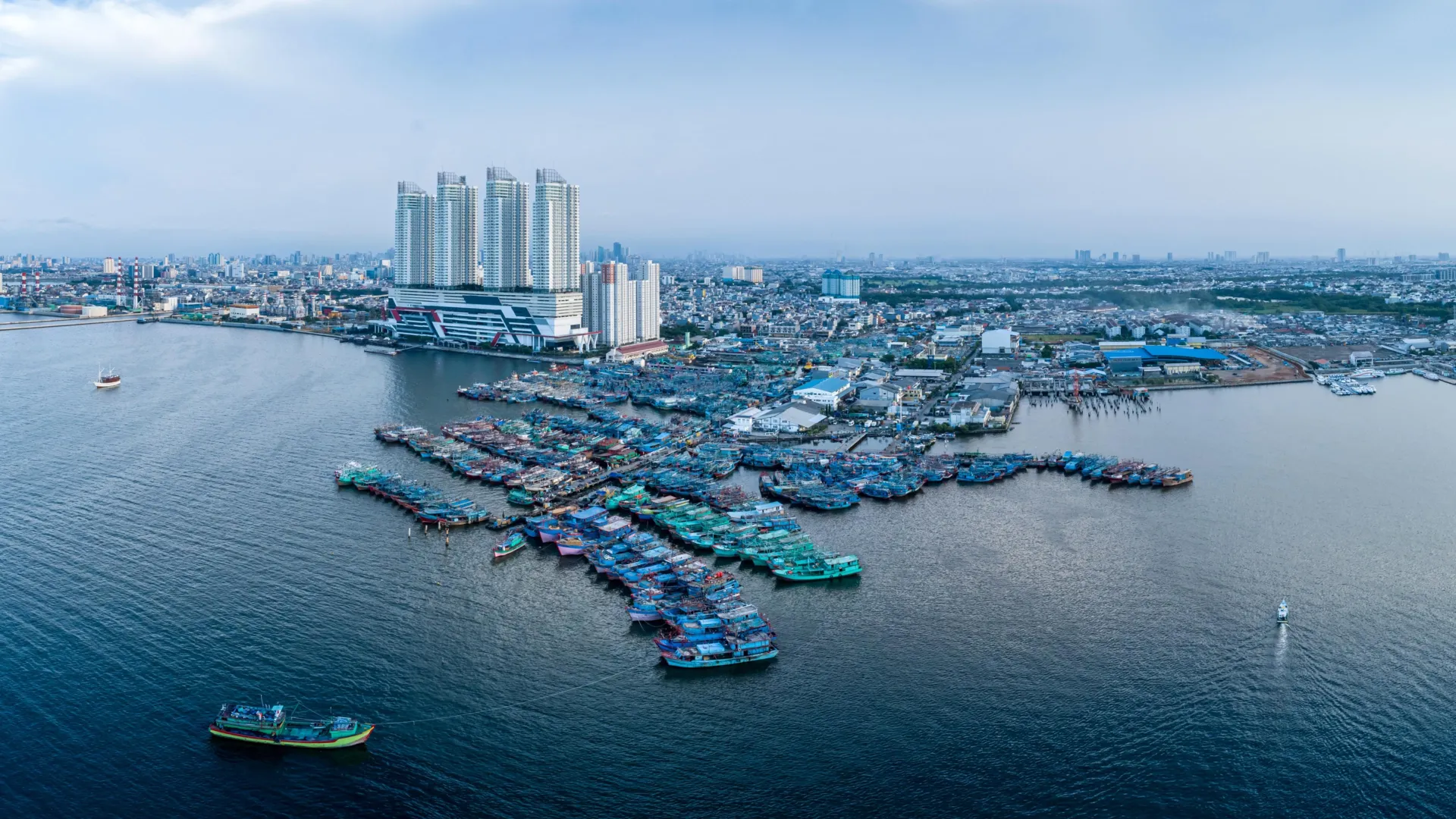
Sinking Ground Accelerates Coastal Flood Risk Worldwide
The ground beneath some of the world's most crowded coastlines is sinking at an alarming rate, amplifying sea-level rise to nearly three times the global coastal average. This hidden threat, driven by groundwater pumping and urban weight, demands urgent attention. We cannot afford to overlook the land itself when planning for climate resilience. For a deeper look at how geological forces reshape coastlines, explore our coverage of Cascadia's Subduction Zone Reveals a Fragmented Tectonic Process.
Improving Forecasts: Detecting Evaporation Ducts Over the South China Sea
Evaporation ducts bend electromagnetic waves in ways that can quietly undermine maritime radar and communication forecasts. Over the South China Sea, where shipping lanes hum with activity, those errors carry real consequence. Using the nonlinear local Lyapunov exponent method, we identified sensitive areas concentrated along the coasts of China and Vietnam. Excluding these regions reduced both mean absolute error and root mean square error in path loss predictions, though gains varied between 2024 and 2025.