ocean engineering
3 stories filed under ocean engineering on World Data Ocean. The newest of them: “Validating Autonomous Navigation With a Real-Time Maritime Digital Twin”, “Clearing haze and color bias to sharpen ocean vision for autonomous vessels”, and “Blue Light's Impact on Biofilms: A Step Towards Greener Antifouling”. A real-time digital twin called SEANAV lets researchers validate autonomous navigation without leaving the lab. Clearing haze and color bias from maritime images is not a trivial upgrade, it is a prerequisite for autonomous vessels to navigate safely. A Global Hub for Ocean Intelligence 4 World Data Ocean is a centralized digital platform where researchers, scientists, and ocean enthusiasts converge to… The list below is every ocean engineering story on World Data Ocean, newest first.
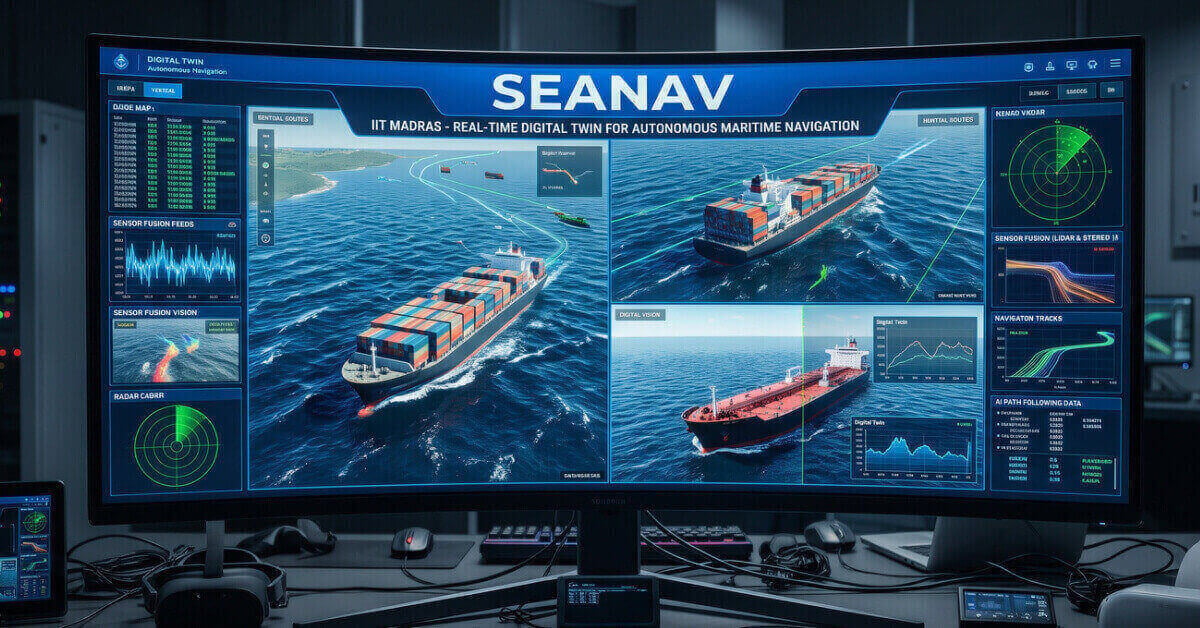
Validating Autonomous Navigation With a Real-Time Maritime Digital Twin
A real-time digital twin called SEANAV lets researchers validate autonomous navigation without leaving the lab. Developed at IIT Madras, this integrated platform simulates realistic maritime environments for testing and training. That is measurable progress toward safer, smarter shipping. Understanding drives protection. Our coverage of rerouting ships to avoid whale sharks, requiring less than one percent extra fuel, shows how such innovations align operational efficiency with ocean stewardship.

Clearing haze and color bias to sharpen ocean vision for autonomous vessels
Clearing haze and color bias from maritime images is not a trivial upgrade, it is a prerequisite for autonomous vessels to navigate safely. Conventional dehazing models fail under spatially uneven haze and persistent blue-green casts. This paper introduces a physics-driven Adaptive HazeData generator, a Color-Aware Channel Attention module, and a scenario-progressive continuous learning strategy. The results are state-of-the-art in structural preservation and color restoration. For real-world validation of autonomous maritime systems, see our coverage of the Sargan-3000 USV's aerial engagement.
Blue Light's Impact on Biofilms: A Step Towards Greener Antifouling
Clean, precise measurements are the backbone of this work, and the data delivers a compelling distinction. The 450 nm light cut total biofilm biomass by 20.9 percent, while 405 nm, though less effective at reducing mass, crushed vertical growth by over 77 percent. That divergence matters. It suggests we are not looking at a single solution, but a toolkit. By mapping these wavelength-specific strengths, this study pushes us toward targeted, chemical-free antifouling.