coral reefs
16 stories filed under coral reefs on World Data Ocean. The newest of them: “Underwater acoustics paired with artificial reefs offer a validated restoration pathway”, “Western Atlantic corals face a critical test of resilience against rising heat”, and “Acoustic restoration: attracting marine life back to damaged reefs with sound”. A coral larva can't read a map, but it can hear a healthy reef. Western Atlantic corals are facing a critical test of resilience. A Global Hub for Ocean Intelligence 4 World Data Ocean is a centralized digital platform where researchers, scientists, and ocean enthusiasts converge to… The list below is every coral reefs story on World Data Ocean, newest first.

Underwater acoustics paired with artificial reefs offer a validated restoration pathway
A coral larva can't read a map, but it can hear a healthy reef. In Kāneʻohe Bay, researchers placed artificial structures with bacterial coatings near underwater speakers playing recordings of snapping shrimp and fish. The result: more coral settlement within 20 meters of the sound source. The evidence for acoustic attraction remains preliminary, yet the integration of engineered habitats, living materials, and ocean intelligence points toward a validated restoration pathway worth scaling. For deeper context on data-driven ocean careers, see *From analytics to ocean intelligence*.
Western Atlantic corals face a critical test of resilience against rising heat
Western Atlantic corals are facing a critical test of resilience. Ever more frequent heat waves and resulting bleaching threaten extinction unless these ecosystems can adapt rapidly. The region's unique geography and long history of pollution have made corals especially vulnerable. Yet evidence shows thermal resilience is increasing through symbiont shuffling and natural selection. Assisted reproduction can accelerate this progress. These promising signs will come to nothing unless overexploitation and pollution are severely reduced.
Acoustic restoration: attracting marine life back to damaged reefs with sound
The segment on *How to Live on Earth* introduced a concept I had not encountered: using recorded sounds from healthy reefs, what the film calls "coral jazz", to draw marine life back to damaged ecosystems. It is a compelling blend of ecology and acoustics. This kind of empirical, restorative research aligns with our coverage of ocean intelligence, including work on translating fishery experience into validated research skills.
A decade of empirical data illuminates the ocean's hidden reef ecosystems
A decade of empirical data now reveals the hidden architecture of our ocean's reef ecosystems, measured, validated, and mapped in real-time. These are not speculative models; they are calibrated observations from orbit to ocean floor. Understanding drives protection. For deeper context on the systemic challenges facing marine environments, see our related coverage on validated data gaps in Europe's marine policy demanding integrated solutions. The science is clear; the call to act is measurable.

A validated open-access observatory for Africa's multi-ecosystem ocean intelligence
The Bazaruto Center for Scientific Studies (BCSS) Ocean Observatory is not another data portal; it is a managed, DOI-linked platform turning eight years of sustained effort into 22 million-plus measurements across six ecosystems. What stands out is the integration: weather, acoustics, biodiversity, and pollution under one interoperable framework, with QA/QC and FAIR compliance built in. This is the baseline Africa's marine science has needed.
Africa's first permanent ocean observatory closes a critical data gap for science and policy
Twenty-two million measurements. That is the scale of what the Bazaruto Center for Scientific Studies and Kisawa Sanctuary have built off Mozambique's coast. Africa's first permanent ocean observatory is not a small pilot project; it is a multi-ecosystem platform covering 6,850 square kilometers, generating high-frequency data across coral, seagrass, and open-ocean habitats. The numbers are impressive, but the real achievement is showing how a Resort-to-Research model can sustain serious science.
Symbiodiniaceae Minicircles Reveal Coral Reef Algae Genomic Variation
The 14 minicircles mapped in *Breviolum psygmophilum* are not just structural curiosities. They reveal a chloroplast genome built for flexibility, where the relative abundance of these plasmid-like DNA molecules shifts between growth phases. This suggests a dynamic mechanism for gene dosage, a level of control absent in the single circular genomes of most plants. It is a compelling glimpse into the evolutionary toolkit that helps power the coral-algae symbiosis.
White Sharks Detected in Gulf of Mexico Sanctuary via Acoustic Telemetry
Nine white sharks, some traveling nearly 3,800 kilometers, have been detected within Flower Garden Banks National Marine Sanctuary, marking the first documented occurrences of the species in this Gulf of Mexico marine protected area. Acoustic telemetry revealed philopatric behavior in two individuals, with returns across multiple years. This empirical evidence expands our understanding of white shark distribution in the western North Atlantic.
Ammonia Fuel's Nitrogen Impact: A New Challenge for Ocean Health
Ammonia fuel's reactive nitrogen footprint remains poorly characterized, even as maritime shipping races toward net-zero emissions by 2050. This review makes clear that emissions across the ammonia fuel value chain, from production leaks to combustion byproducts, could alter marine productivity, drive eutrophication, and harm biodiversity, with impacts varying sharply by region. It is a measured, empirical call for integrated lifecycle accounting. For deeper context on operational innovations, see our coverage of the world's first ship-to-ship ammonia bunkering milestone.
Advancing Underwater Imaging: A New Filter for Clearer Ocean Insights
Clear water is a luxury underwater images rarely enjoy. Haze, wavelength-dependent absorption, and scattering routinely strip clarity from marine observation, yet most enhancement methods treat these as uniform noise rather than physical realities. The proposed RSADAF framework changes that calculus. By embedding Rayleigh scattering directly into a second-order diffusion model, the authors give the filter true wavelength awareness, allowing it to suppress degradation while preserving structural edges. The benchmark results, including a PSNR of 42.85 dB, speak for themselves. This is practical, interpretable ocean intelligence.
Microbiome Manipulation Reveals Coral Health and Resilience Insights.
Coral health is not a fixed state but a dynamic balance, and a new study shows that manipulating the microbiome can tip that balance toward resilience. This research offers a measurable, peer-reviewed path forward for reef conservation, moving beyond observation to intervention. We see this as a vital step in building ocean intelligence, and it pairs well with our coverage in "Magma and microbial activity may rewrite a 2-billion-year-old carbon signal." Understanding these biological levers is how we turn insight into protection.
Ocean Warming's Ripple Effects: A Growing Threat to Human Health
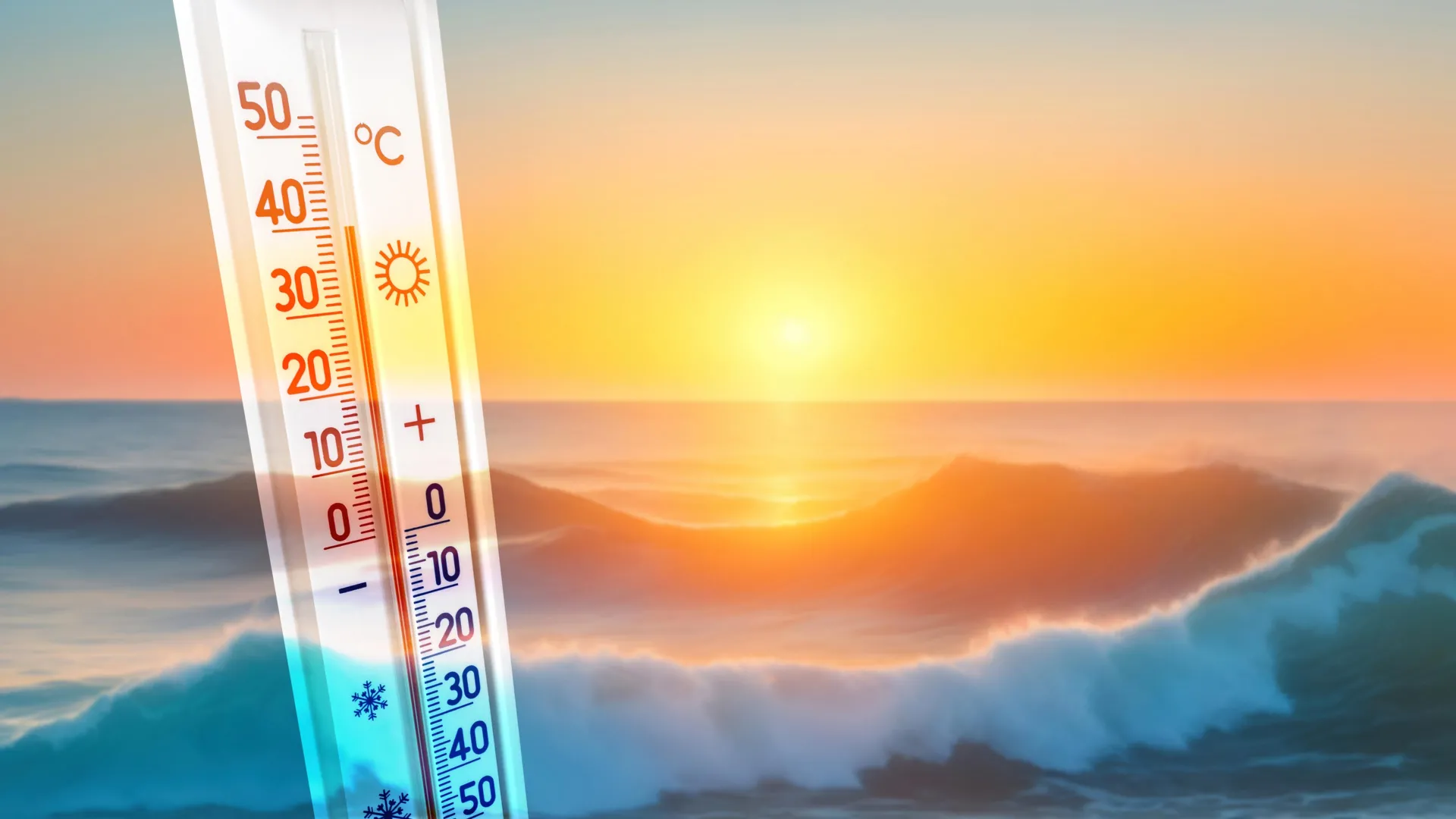
Marine heatwaves are no longer just an ocean problem. They are a human health problem, and that distinction matters. As unusually hot waters fuel stronger storms, trigger harmful algal blooms, and strain seafood supplies, coastal communities face mounting risks to their livelihoods and mental well-being, from anxiety to grief. This is a measurable, peer-reviewed concern that demands our attention. Understanding these ripple effects is the first step toward integrated responses.
Caribbean Offshore Wind: Balancing Energy Needs and Marine Planning.
Offshore wind holds real promise for Caribbean energy security, but its path forward depends on where we choose to build. This study gets that. By layering wind climatologies with ecological constraints across 12 SIDS, it maps 10.03% of maritime space as viable opportunity zones while revealing a striking decoupling: only 0.36% forces trade-offs. That clarity matters. The framework turns vague national aggregates into actionable, sub-EEZ siting strategies.
Empirical Evidence: Young Scientists Document Ocean Changes, Challenge Climate Denial
Diane and Bronwyn didn't wait for a lecture to prove what they already suspected. They gathered their own observations, measured what they could, and brought the evidence to their science teacher. Their work is a reminder that empirical truth doesn't require permission. Climate denial weakens when met with calibrated, real-world data. These young women aren't just documenting change; they're modeling how inquiry can counter assumption.
Bridging Research and Collaboration: Marine Science Opportunities in Indonesia
A Fulbright research grant is a commitment to shared understanding, and for this student, it starts with a practical problem: securing a sponsor. The visa requires a named partner, even when funding is self-arranged. This is a common hurdle, but one that demands creative networking. The request is straightforward, and the solution lies in connection. For those in Indonesian marine science, your networks are the bridge. We recommend reading *Bridging Data Gaps: Integrating Citizen Science for Ocean Intelligence* for related context on collaborative research.
Guadeloupe's Coral Reefs: A Decade of Change and Challenges Observed.
Ten years of monitoring reveal what many on the ground have long suspected: Guadeloupe's coral reefs are not simply changing, they are degrading with increasing speed. The data, drawn from 14 sites, show that algal dominance was already established before 2014, but the acceleration after 2020 is striking. Turbidity and nutrient enrichment are the primary drivers, not distant warming alone. The story is one of local pressures compounding regional crises. For those tracking ocean intelligence, this is a clear signal.