Japan Plans World’s Largest Floating Offshore Wind Farm To Power Tokyo
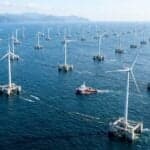


Japan is moving ahead with plans to build the world’s largest floating offshore wind farm off the Izu island chain, with a target to generate at least 1 gigawatt (GW) of electricity for both the islands and mainland Tokyo by 2035.
The Tokyo Metropolitan Government is targeting completion by 2035, with the project expected to generate power roughly equivalent in installed capacity to one nuclear reactor.
If completed as planned, it would be around ten times larger than the biggest floating offshore wind farm currently operating in Norway, which produces less than 100 megawatts.
Governor Yuriko Koike first introduced the project vision during COP29 in 2024.
Since fiscal 2025, Tokyo authorities have been consulting residents as well as fishing and shipping stakeholders across the affected island municipalities, including Oshima, Niijima, Kozushima, Miyake and Hachijo.
To support the next phase, the Tokyo government has reportedly tripled its fiscal 2026 budget for the project to 2.7 billion yen ($17 million), directing funds toward wind resource studies, seabed soil analysis and cable routing surveys.
Field studies are now set to examine seabed topography, weather conditions and marine conditions in the area as officials prepare for future commercial bidding.
Unlike bottom-fixed offshore wind farms, floating wind turbines sit on buoyant platforms anchored to the seabed through mooring systems.
This allows deployment in deeper waters where conventional foundations are not practical, particularly in depths of 100 to 200 meters, which characterize the project area.
Officials have pointed to another advantage: floating foundations can reduce seabed disturbance during installation compared to pile-driven bottom-fixed structures.
Electricity generated offshore would be transmitted to shore through high-voltage subsea cables laid along the seabed, linking remote maritime sites with island communities and the mainland power grid.
The project also supports Japan’s national goal of reaching 45 GW of offshore wind capacity by 2040 and its 2050 net-zero target. The Izu region is known for strong winds, which officials see as supporting the project’s long-term potential.
Still, major challenges remain.
The Izu region is currently classified only as a preparation zone, the earliest development stage, and some analysts have questioned whether the 2035 target is realistic given offshore wind projects often take more than a decade to move from planning to operation.
There are also concerns from the private sector over profitability and risks linked to offshore wind investments. Those concerns grew after Mitsubishi Corp. pulled out of major wind projects in northern Japan in 2025, citing rising material costs and the weaker yen.
Experts have also pointed out that while the project’s installed capacity may match a nuclear reactor at 1 GW, actual power output would likely be lower because wind farms generally operate at around 40 percent capacity, compared with 80 to 90 percent for nuclear plants.
Floating wind also remains a small part of global wind installations, and analysts say Japan still trails Europe in the technology.
The project faces engineering challenges as well. Turbines would need to withstand typhoons, strong currents and seismic activity in Japanese waters, requiring specially designed platforms and mooring systems.
Government planners have said the 1 GW project could generate enough electricity for about 850,000 households. Platform construction is expected to support Japanese shipyards and could create jobs in coastal regions.
Grid connection is another issue under review, as new transmission infrastructure would be needed to bring the electricity ashore and manage variable wind generation.
Environmental concerns are also being studied, particularly possible effects on marine ecosystems and access to fishing grounds.
Japan has been looking to expand renewable energy partly because of energy security concerns that grew after the Fukushima disaster in 2011.
Officials also see floating offshore wind as important for countries with deep coastal waters and limited land available for large-scale renewable projects.
References: interestingengineering, evadaily
Want to read more?
Check out the full article on the original site