U.S. Navy Gets First Payload Module For Virginia-Class Submarine USS Arizona
Our take
## Our Take: The USS Arizona’s Payload Module – A Step Towards Enhanced Ocean Intelligence Capabilities
The arrival of the first payload module for the Virginia-class submarine USS Arizona marks a significant advancement in the U.S. Navy’s operational capabilities and, crucially, underscores the evolving role of submarines in gathering and processing ocean data. This 184-foot section, now undergoing integration at Electric Boat’s Groton facility, represents a modular design intended to allow for rapid reconfiguration and deployment of specialized equipment, moving beyond the traditional, fixed-capability submarine. It’s a development that resonates deeply with World Data Ocean’s mission to build a comprehensive, real-time understanding of the world's oceans. The shift towards modular payloads allows for a level of adaptability previously unseen, enabling submarines to respond to emerging threats and evolving research priorities with greater agility. The integration of this module builds upon the advancements seen in previous Virginia-class vessels, particularly those designated as SSBNs (Strategic Submarine Ballistic Nuclear), highlighting a broader trend towards multi-mission platforms. For further context on the evolving capabilities of Virginia-class submarines, see Virginia-Class Submarines: A Modern Marvel.
The significance of this development extends beyond simply enhancing the submarine's operational flexibility. The payload module is expected to house advanced sensor suites and data processing capabilities, allowing the USS Arizona to contribute significantly to ocean intelligence gathering. This includes, but isn’t limited to, monitoring climate indicators, tracking marine life populations, and assessing oceanographic conditions. The ability to collect and analyze this data in real-time, while submerged, offers a distinct advantage over surface-based platforms, which are more vulnerable to weather and detection. This ties directly into the concept of an integrated data ecosystem, where data streams from various sources – satellites, buoys, surface vessels, and now submarines – converge to create a holistic view of the ocean. The modularity of the payload allows for continuous upgrades and integration of new technologies, ensuring that the USS Arizona remains at the forefront of ocean data acquisition. Related to this, the development of advanced underwater acoustic monitoring systems is critical; explore Underwater Acoustic Monitoring for insights into the complexity of this field. The Navy’s investment in this area directly supports the validation and calibration of data collected by other oceanographic instruments, contributing to the overall accuracy and reliability of ocean intelligence.
The broader implications for the oceanographic research community are considerable. Traditionally, access to deep-ocean data has been limited and costly. The increased operational availability of submarines equipped with advanced sensor suites, coupled with the potential for data sharing protocols, could revolutionize our understanding of deep-sea ecosystems, geological processes, and the impact of climate change on the ocean's depths. This shift necessitates a collaborative approach, bringing together naval engineers, oceanographers, and data scientists to ensure that the collected data is effectively utilized and disseminated. The emphasis here should be on fostering open science principles and ensuring data accessibility while safeguarding national security considerations. The validated, empirical data collected by platforms like the USS Arizona will be crucial for refining climate models and developing effective strategies for ocean stewardship. This is a tangible example of how technological innovation, driven by defense needs, can inadvertently benefit broader scientific endeavors.
Looking forward, the key question becomes: how will the data collected by these advanced submarines be integrated into a global ocean intelligence framework? Will protocols be established for sharing data with international partners, and how will data privacy and security be addressed? The potential for creating a truly comprehensive, real-time ocean intelligence network is within reach, but it will require a concerted effort to overcome technical, political, and logistical challenges. The successful integration of the USS Arizona’s payload module is a critical first step, but the long-term vision must encompass a collaborative, open-science approach to unlock the full potential of this transformative technology. Further, the long-term impact of these advanced systems on marine ecosystems and acoustic environments warrants careful monitoring; see Impact of Sonar on Marine Life for an overview of these considerations.
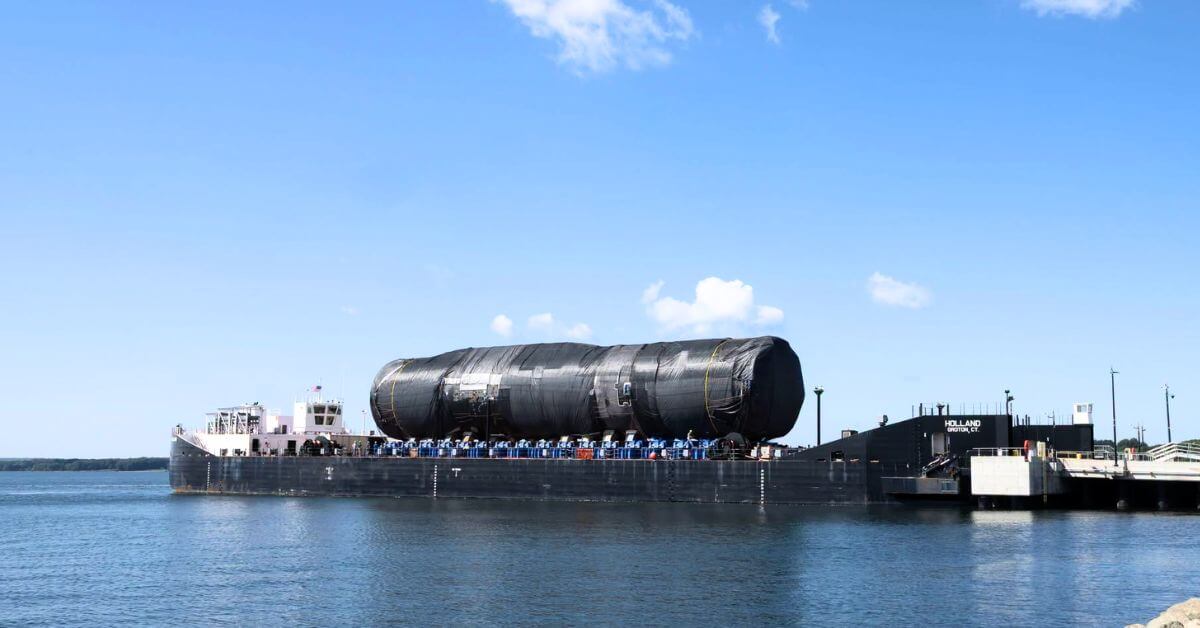
General Dynamics Electric Boat has completed the first Virginia Payload Module (VPM) for the U.S. Navy’s Virginia-class submarines.
The 184-foot section was moved by barge from Quonset Point to Electric Boat’s facility in Groton, Connecticut. It will be installed on the future USS Arizona (SSGN-803).
Electric Boat said the move was the largest Virginia-class section shipment so far.
The VPM will give Virginia-class submarines space for up to 28 more Tomahawk-sized missiles. The module can also carry Conventional Prompt Strike (CPS) hypersonic boost-glide weapons.
The extra missile space will help replace some of the capacity now provided by four converted Ohio-class submarines as those older boats leave service.
Electric Boat shared a photo of the section on Facebook. The company said the USS Arizona will be about 460 feet long when finished.
The VPM has four large canisters. Each canister can hold seven Tomahawk-sized missiles. Together, they can carry up to 28 missiles.
The submarine also has two Virginia Payload Tubes in its bow. Each tube can hold six missiles. This gives the submarine a total vertical-launch capacity of up to 40 missiles.
The VPM can also be used for CPS weapons instead of Tomahawk-sized missiles. Each of its four canisters can hold three CPS hypersonic boost-glide weapons.
The Navy uses the same CPS mounting systems on Zumwalt-class destroyers after their conversions. The larger launch system could also be used for other weapons.
Naval News has reported on work to develop a submarine-launched version of the AARGM-ER anti-radiation missile. The missile would give U.S. submarines a way to target radar systems.
The War Zone has also reported on an effort to give submarines an anti-air capability using a version of the Navy Modular Missile. It is the Navy’s prospective next-generation interceptor and is expected to be used from submarine vertical-launch systems.
19 Submarines to Get the VPM
USS Arizona will be the first U.S. Navy submarine to receive the VPM. It is expected to be the second Block V Virginia-class submarine to enter service, after USS Oklahoma (SSN-802).
The Navy plans to put the VPM on 19 Virginia-class submarines. This includes 12 Block V and seven Block VI submarines. The upgrades are planned over the next two decades.
Each submarine with a VPM will be 83 feet longer than earlier Virginia-class boats.
The VPM section itself is about 184 feet long. The completed submarine will be about 460 feet long.
The 19 submarines will also have upgrades already introduced on earlier Virginia-class boats. These include a side-mounted sonar array first used on the Block V submarines.
Replacing Older Ohio-Class Capacity
The VPM will also help replace missile capacity that will be lost when older Ohio-class submarines leave service.
The first four Ohio-class submarines were converted in the early 2000s. They were changed to carry conventional weapons instead of their original 16 Trident submarine-launched ballistic missiles.
Each converted submarine can carry 154 Tomahawk land-attack cruise missiles.
The conversions allowed the four submarines to stay in service instead of retiring early. They now provide most of the U.S. submarine fleet’s conventional vertical-launch capacity.
But the four submarines are more than 40 years old and will eventually leave service.
Their retirement will create a gap in conventional VLS capacity.
The VPM-equipped Virginia-class submarines are planned to replace that capacity and spread it across more modern submarines.
When all 19 VPM-equipped submarines are in service, the Navy will have more VLS cells overall.
In July, General Dynamics Electric Boat received a $42.1 billion contract to build nine more Virginia-class submarines.
References: navalnews, forbes
Read on the original site
Open the publisher's page for the full experience