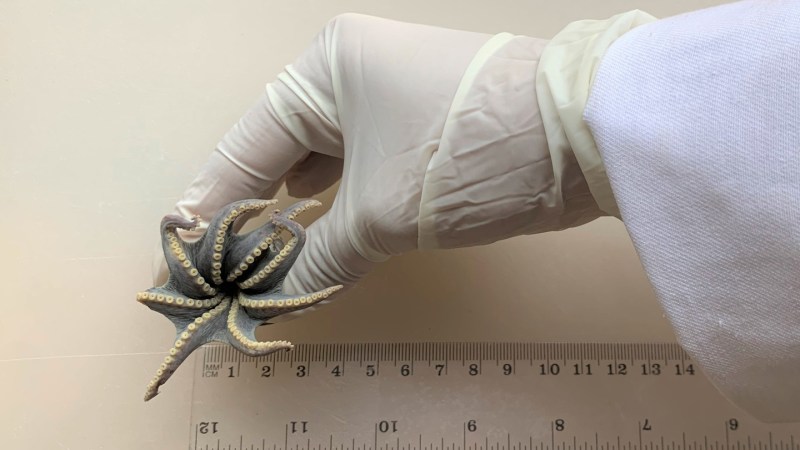
The recent discovery of a diminutive, fully mature octopus, barely fitting in a human palm, offers a fascinating glimpse into the biodiversity of the deep sea and underscores the potential for rapid adaptation within cephalopod populations. This finding, while seemingly small in scale, carries significant implications for our understanding of reproductive strategies and evolutionary pressures in extreme environments. Its existence further highlights the vital need for continued exploration and data collection in the underexplored deep ocean – an area increasingly impacted by human activity. Our work on AIS-driven vessel activity and emissions modelling for offshore decommissioning activities in the North Sea demonstrates the growing need to account for the impact of human endeavors, even in remote areas, and this discovery serves as a reminder of the potential for unforeseen ecological consequences. The potential for accelerated reproduction, based on the researchers’ hypothesis, could be a crucial adaptation to fluctuating deep-sea conditions, or perhaps a response to predation pressures we are only beginning to understand.
The unique characteristics of this tiny octopus – its rapid maturity despite its small size – suggest a potentially distinct evolutionary lineage. Understanding this lineage requires a rigorous, empirical approach, utilizing calibrated methodologies to determine its phylogenetic relationship to other octopus species. This type of detailed analysis is consistent with the frameworks outlined in our piece on A framework for overcoming challenges in marine invertebrate cell culture for research and conservation, which emphasizes the importance of robust research methods for assessing and protecting marine biodiversity. Furthermore, the discovery’s relevance extends beyond simply cataloging a new species; it prompts questions about the broader patterns of miniaturization and rapid reproduction observed across various deep-sea organisms. The fact that this creature is fully mature at such a small size suggests it may have evolved a reproductive strategy tailored to the unique constraints of the deep-sea environment, potentially requiring less energy investment per offspring but relying on a high reproductive rate. Observing these adaptations in context with the interconnectedness of marine life, as our documentation of remora (Remora remora) attachment to a nesting olive ridley sea turtle (Lepidochelys olivacea) in Playa Pejeperro, Costa Rica illustrates, further emphasizes the delicate balances within these ecosystems.
The discovery also reinforces the critical role of integrated data ecosystems in advancing our understanding of the ocean. Real-time data collection, coupled with longitudinal studies, are essential for tracking changes in deep-sea populations and assessing the impact of environmental stressors. The ability to correlate observed changes in species distribution and behavior with measurable climate indicators allows for a more predictive and proactive approach to ocean stewardship. This new octopus serves as a potent example of the unknowns that still exist within the deep sea; even with advances in remotely operated vehicles (ROVs) and other exploration technologies, vast areas remain unmapped and unexplored. Validated data, generated through rigorous scientific processes, becomes the foundation for informed policy decisions and effective conservation strategies. We must continue to invest in technological innovation and collaborative research to bridge the knowledge gaps and protect these fragile ecosystems.
Looking ahead, a critical question is whether this rapid reproductive strategy is widespread among deep-sea cephalopods, or if this tiny octopus represents a unique adaptation. Further research focusing on the genetic basis of this rapid maturation, as well as the ecological factors that have shaped its evolution, is warranted. The potential for this species to serve as a bioindicator of deep-sea environmental health is also worth exploring, providing us with an early warning system for changes in ocean conditions. Ultimately, this discovery underscores the profound need for a global, collaborative approach to ocean exploration and conservation, prioritizing empirical research and validated data to ensure the long-term health and resilience of our planet's most vital ecosystem.