Port Automation: The Reality Nobody Tells You
Our take
The current discourse surrounding port automation frequently emphasizes the transformative power of artificial intelligence, often overlooking a crucial reality: successful implementation demands a far more nuanced approach. While AI undeniably plays a vital role, the article "Port Automation: The Reality Nobody Tells You" rightly highlights the significance of workforce skills development and phased rollouts. The pursuit of faster turnaround times, as evidenced by recent reports of Global Port Congestion Reaches New High With 4.3 Million TEU Vessel Capacity Waiting To Berth, necessitates a holistic strategy that acknowledges the human element alongside technological advancements. Simply deploying advanced systems without adequately preparing the workforce to operate and maintain them risks creating bottlenecks and diminishing the anticipated efficiency gains. This echoes the broader challenges in integrating new technologies across industries, requiring proactive investment in training and adaptation rather than a purely technological fix.
The discussion around terminal operating systems (TOS) is particularly relevant here. Modular solutions, such as the Infyz iTOMS mentioned in the article, offer a pathway toward phased automation, allowing terminals to incrementally adopt new technologies while minimizing disruption to existing operations. This contrasts with the “rip and replace” approach that has historically plagued industry implementations, resulting in costly overhauls and prolonged downtime. Considering the complexities of maritime resource allocation, as explored in Analysis on transfer pricing of sea area use rights based on market equilibrium theory, a gradual, calibrated rollout of automation allows for continuous monitoring and optimization, ensuring alignment with evolving market conditions and regulatory frameworks. Furthermore, the potential for automation to impact maritime careers, as potentially explored by aspiring marine archaeologists I wanna become a Marine Archeologist, necessitates careful planning and retraining programs to mitigate displacement and ensure a skilled workforce remains available.
Beyond the immediate operational benefits, the broader implications of port automation extend to global supply chain resilience and environmental sustainability. Efficient ports are critical for minimizing delays and reducing fuel consumption, contributing to lower carbon emissions. Data-driven insights derived from integrated data ecosystems within automated ports can facilitate predictive maintenance, optimize vessel routing, and improve overall resource utilization. However, achieving these benefits requires a commitment to interoperability and standardized data formats, enabling seamless information exchange between different stakeholders across the maritime ecosystem. The shift towards real-time, validated data, facilitated by technologies like IoT sensors and advanced analytics, is paramount for creating a truly intelligent and responsive port infrastructure. This emphasis on data integrity aligns with the core principles of World Data Ocean, underscoring the need for rigorous validation and calibration of the data driving these automated systems.
Ultimately, the successful navigation of port automation requires a paradigm shift from a purely technology-centric view to a human-centered, systems-thinking approach. The initial hype surrounding AI's transformative potential must give way to a more pragmatic understanding of the complexities involved. The future of port operations hinges not solely on the sophistication of the technology deployed, but on the adaptability of the workforce, the modularity of the solutions, and the robustness of the integrated data ecosystem supporting it. A key question to watch is whether industry stakeholders will embrace this nuanced perspective, prioritizing long-term sustainability and resilience over short-term gains, and ensuring that the benefits of automation are shared equitably across the maritime community.
Everybody in the shipping sector is talking about how automation and AI are helping achieve faster turnaround times at ports, increasing efficiency, boosting overall performance, reducing errors, and a lot of case studies and news pieces are being published supporting the same.
Everything is true, as we already outlined in the previous article (The $6.9 Billion Cost of Non-Automated Port Operations: Why Delays Are Becoming More Expensive). However, one thing which most stakeholders might overlook is the training that port workers and staff need to work efficiently with the new terminal operating systems. What good is AI or a new technology if those using it do not know how to operate it to its full potential?
Stakeholders or decision-makers often resist the change to automated operations at their ports or terminals simply because they might be confused as to how to go about it, what to tell the workers, how to convince them of a new mode of operation, and how to secure approvals from management without dragging the case for too long.
Automation does not mean fewer staff; it just changes the kind of workers you need.
One might assume that automation translates to fewer port workers; however, this is not so.
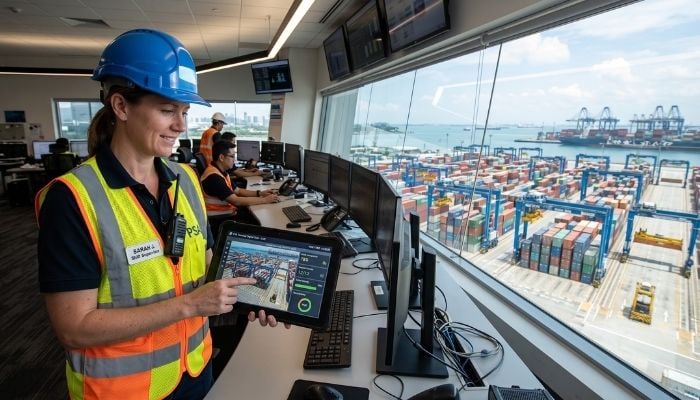
While automation removes some manual tasks, a facility still requires specialists like automation engineers, robotic technicians, electrical engineers, IT/OT Specialists, and control-system specialists- basically the same people but with an upgraded skill set, allowing them to make the best use of the new systems powered by automation and AI.
Rotterdam could be a case to explain this point. The port is handling less cargo than it did in 2021, yet its terminals are running at 78% capacity. This is because there aren’t enough skilled people to handle the new system; Pronto and PortAI can accurately predict ship arrival times, coordinate logistics, and optimise truck and rail movements.
There are also unmanned electric vehicles which run through its container yards with the help of magnetic grids, along with automated stacking cranes which do their work without human intervention. This shows that automation or advanced systems without human skills, knowledge and expertise alone cannot boost performance or efficiency.
A study conducted in 2024 by the research group TNO found that unfilled technical jobs were costing Rotterdam around €180 million a year in lost productivity. Rotterdam World Gateway spent 11 months trying to fill a senior manager role for terminal automation.
This is part of the thinking behind Infyz Solutions’ terminal operating system, iTOMS. Instead of assuming every terminal can hire and staff up the way Rotterdam is doing, iTOMS is built to make the system easier to run with the staff you already have, with no need for new training or rehiring people to run the new system.
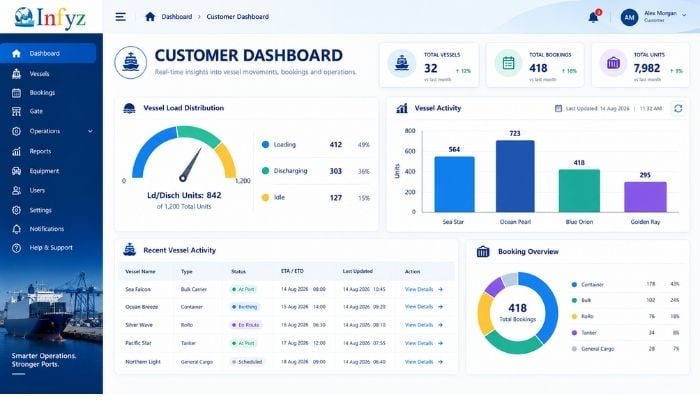
A shift supervisor can simply ask the system something like “how many appointments do we have today” or “what’s our current yard occupancy,” instead of having to wait on a specialist role that might not even exist on the team yet.
Being “automated” doesn’t mean you get the productivity you were promised
The real selling point of automation is greater productivity, but research published in Transport Reviews, along with studies from groups like Porteconomics and METRANS, shows that the gains people expect on paper tend to reduce once you factor in congestion, a mix of manual and automated work, and everyday operational issues.
Part of the gap comes down to how well systems talk to each other and how much visibility you actually have. A terminal planning its day around yesterday’s data will always fall behind one that can see what’s happening right now.
That’s the gap Infyz’s digital twin and yard-optimisation tool is meant to close: a live view of the yard connected straight to the database that updates continuously instead of just once per shift, with heat maps, cargo-ageing tracking, and destination filters built in, all providing information in real time.
The biggest risk is trying to do everything at once
The riskiest way to automate is to replace most of your manual operations at once or simultaneously. If one system from one vendor controls everything- gate operations, yard planning, berth planning, equipment, and the rest- then a single module failing during the switch-over can put the whole terminal’s operations at risk.
Doing a big manual-to-automation switch all at once also means dealing with training, hiring, integration, and approvals all at the same time.
Terminals that roll automation out in stages- gate operations this year, yard planning next year, berth optimisation after that- can build expertise along the way and prove the system works step by step, instead of risking their entire throughput on one changeover.
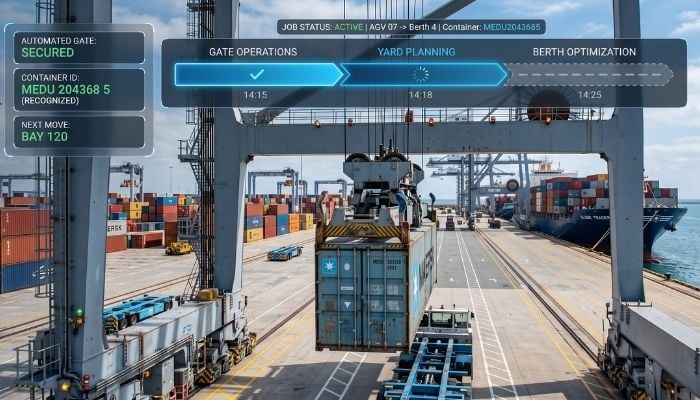
This matters more for terminals handling multiple types of cargo, since most terminal operating systems are built around just one cargo type. A terminal handling containers, bulk, and RoRo cargo might end up needing to connect two or three separate systems, which only adds more risk to the switch-over.
This is exactly what Infyz Solutions built iTOMS to avoid. Instead of needing a separate system for each cargo type, iTOMS is one modular system that handles containers, bulk, break-bulk, and RoRo operations together.
iTOMS can be implemented incrementally, enabling defined operational workflows to go live initially within a few weeks, while the overall timeline is tailored to the terminal’s operational landscape. Subsequent updates typically require only 15–30 minutes of downtime, allowing terminals to automate workflows progressively while minimising integration risk across different cargo types and operational processes.
What to ask before you sign anything
None of this means you should avoid automation. The billions lost to demurrage costs are reason enough to keep moving forward. It just means you should ask different questions before signing the contract.
- Who will actually run the new system? Will this system make the job easier for the staff you already have, or will you need to hire people with upgraded, specialised skills?
- Can you roll it out gradually? Can you start with one part of the operation, prove it works, and then expand from there
- What productivity gain will you actually see? What improvement can you expect for your terminal, your cargo, and your operating conditions?
- Can you see what’s happening in real time instead of a monthly report? Is there real-time visibility into equipment performance, terminal productivity, delays, bottlenecks, system failures, and cargo movement?
Port automation isn’t just a software project; it’s a multi-year change to how the organisation works, and the software is just one part of it. Terminals that understand this and choose a platform built for that reality, the way Infyz has approached it with iTOMS, are in a better position to get the results automation and AI promise.
You might also like to read-
- What Can Operators Expect From a Modern Terminal Operating System (TOS) ?
- Why Modern Terminals Are Replacing Legacy Software with AI?
- The $6.9 Billion Cost of Non-Automated Port Operations: Why Delays Are Becoming More Expensive
Read on the original site
Open the publisher's page for the full experience