Chinese Naval Scientists Back Big Guns On Trump-Class Warships To Counter Drone Swarms
Our take

## Our Take: Escalating Naval Strategies and the Evolving Threat Landscape
The recent reports detailing Chinese naval scientists advocating for the deployment of large caliber naval guns on modernized warships, specifically in response to the proliferation of drone swarms, represent a significant shift in strategic thinking and a validation of concerns regarding evolving maritime warfare. This isn’t merely a technological upgrade; it signals a reassessment of defensive capabilities against a rapidly changing threat vector. The rationale, as presented, centers on the ability of large guns to effectively engage and disrupt coordinated drone attacks, a vulnerability increasingly recognized by naval forces globally. The proposed “Trump-Class” warships, equipped with nine large guns alongside missiles and electromagnetic weaponry, represent a layered defense system designed to address the challenges posed by low-cost, high-volume drone swarms. This development necessitates a broader examination of naval modernization strategies and the prioritization of counter-drone technologies across various maritime nations. For context, consider the ongoing discussions regarding autonomous naval systems, as explored in Autonomous Vessels: A Rising Tide, and the vulnerabilities these technologies themselves introduce. Furthermore, the emphasis on traditional gunnery alongside advanced weaponry highlights a pragmatic approach, acknowledging that technological solutions are rarely singular and often require a blend of established and emerging capabilities.
The Chinese decision to revisit large caliber naval guns is particularly noteworthy given the decades-long trend toward diminishing their role in modern navies. The perceived obsolescence of battleships and large gun platforms stemmed from the rise of missile technology and the belief that precision-guided munitions rendered them largely ineffective against modern warships. However, the emergence of drone swarms, characterized by their low cost, maneuverability, and potential to overwhelm defenses, has forced a re-evaluation of this assumption. Drone swarms pose a unique challenge: their sheer numbers and distributed nature make them difficult to intercept with traditional missile defense systems. Large caliber guns offer a potential solution by providing a rapid-fire, area-denial capability, capable of engaging multiple targets simultaneously and disrupting swarm coordination. This development also has implications for naval doctrine, potentially leading to a greater emphasis on close-range defense and the integration of gunnery with other defensive systems. The recent analysis of naval power projection strategies in the Indo-Pacific region, detailed in Naval Power Projection in a Shifting Geopolitical Landscape, underscores the increasing importance of defensive capabilities in maintaining regional stability.
Beyond the immediate tactical implications, this development highlights the broader trend of adapting military technologies to address asymmetric threats. The proliferation of drones, initially conceived for civilian applications, has created a new landscape of potential adversaries, ranging from state actors to non-state entities. This necessitates a shift from solely focusing on traditional peer-to-peer warfare to developing robust defenses against unconventional attack vectors. The Chinese approach – integrating proven technologies like large caliber guns with advanced missile and electromagnetic systems – demonstrates a pragmatic and adaptive strategy. It also underscores the potential for a resurgence of older technologies, re-calibrated and re-purposed to meet contemporary challenges. The investment in these systems also suggests a long-term perspective on maritime security, recognizing the persistent threat of drone-based attacks and the need for layered defenses. Understanding the intricacies of maritime defense systems, including radar and sensor technologies, is crucial for comprehending the full scope of this development. Our report on Advanced Maritime Sensor Technologies provides a deeper dive into these critical components.
Looking ahead, the deployment of these modernized warships will undoubtedly influence naval modernization programs across the globe. We can anticipate increased investment in counter-drone technologies, a renewed focus on gunnery systems, and a greater emphasis on integrated defense architectures. The question becomes: will other naval powers follow suit, or will they pursue alternative approaches to countering drone swarms? The effectiveness of these "Trump-Class" warships in real-world scenarios will be a key determinant in shaping future naval strategy. Furthermore, the potential for an arms race in drone technology and counter-drone systems remains a significant concern, demanding careful monitoring and a proactive approach to international cooperation in establishing norms and regulations for the use of unmanned systems at sea.
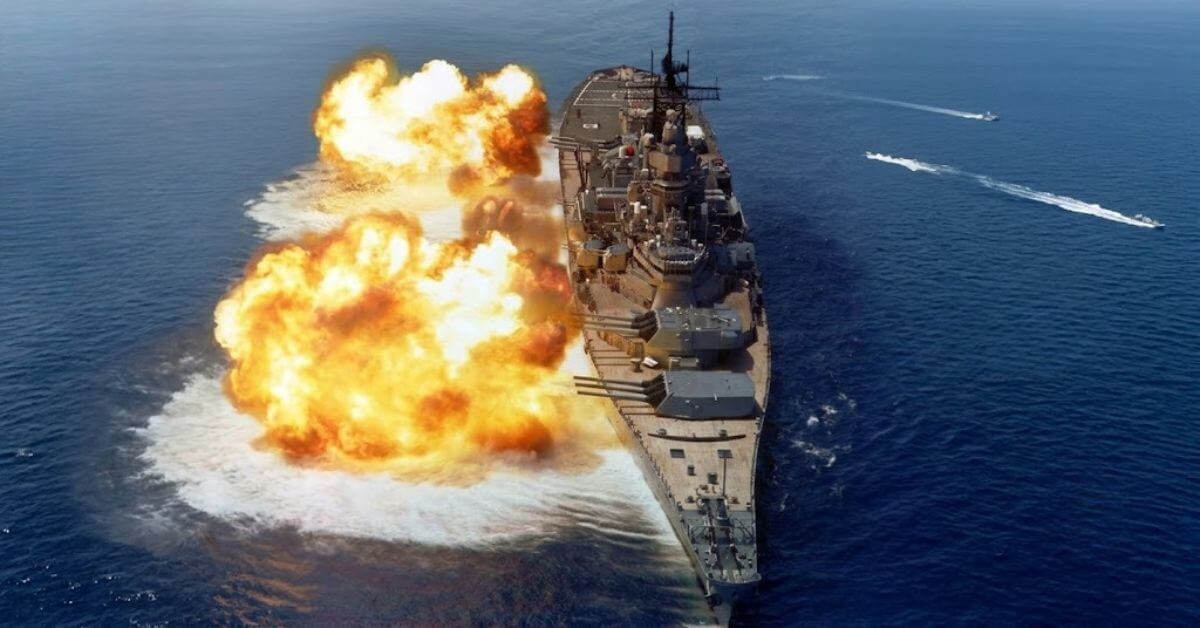
Chinese military researchers say large naval guns could be useful against drone swarms, giving some support to a part of U.S. President Donald Trump’s plan for a new class of battleships.
The researchers looked at shells that can explode close to a group of drones and spread thousands of fragments. They say this could allow one shell to damage more than one drone without hitting each drone directly.
The study was published last month in the Chinese peer-reviewed journal Command Control & Simulation.
The proposed battleships would carry 9 large naval guns, along with a large number of missiles and other electromagnetic weapons.
Chinese researchers test the idea
Wang Lei and his team from PLA’s Dalian Naval Academy studied how large-calibre guns could be used against a group of small unmanned weapons.
They did not treat the shell as a weapon that had to hit one drone. Instead, they looked at what would happen if the shell exploded near the group and sent fragments in different directions.
For their example, the researchers used 30 Russian-made Lancet-3 loitering munitions.
Each Lancet-3 has a maximum take-off mass of about 12 kg (26 lb) and can carry a payload of up to 3 kg.
The researchers assumed that one shell would create 2,000 fragments. They estimated that 1,589 of those fragments would be heavy enough to cause damage.
Their model also used a fragment-cloud kill radius of 15 metres (49 feet).
With those assumptions, the researchers calculated a 3.95% chance of damaging any one drone.
For a swarm of 30 drones, one shell could therefore damage about 1.19 drones, according to the study.
These are results from the researchers’ model. They are not based on a battlefield test.
Guns would not work alone
The researchers said the system would need accurate detection and tracking. It would also need good fire-control systems and programmable fuses.
They suggested using the guns together with electronic warfare, lasers and command-and-control systems.
The idea is to use different systems to defend a warship rather than depend on the guns alone.
The study also points to the problem created by cheap drones. A relatively inexpensive drone can force a warship to consider how much it should spend to stop it.
Trump’s battleship plan faces criticism
Trump announced the proposed Trump-class battleship in December as part of his planned “Golden Fleet”.
The design includes nine large naval guns, extensive missile capacity and other electromagnetic weapons.
The plan has been criticised by experts and social media users. They have questioned whether putting so much firepower on one very expensive ship makes sense when modern navies also face long-range missiles and unmanned weapons.
One U.S. online commenter called the plan “designed by a rich moron with no concept of practicality or functionality”.
Another joked that the ships would be “quite literally gold-plated”, referring to their perceived wastefulness and high cost.
Another post compared the design to a “Swiss army knife” that tried to do everything but was “useless at everything”.
Military analysts have also raised concerns about the idea. Military.com has argued that battleships have long been vulnerable to aircraft, submarines and missiles.
Battleship programme could cost billions
The U.S. Congressional Budget Office estimated in August that the first nuclear-powered battleship could cost about $23.4 billion.
A programme involving 15 ships could cost roughly $275 billion, according to the estimate.
The U.S. Navy says it plans to order 15 Trump-class battleships between 2028 and 2056.
Chinese expert also rejects the idea
The proposal has also faced criticism in China.
One Chinese weapons and equipment specialist said the study did not show that large-calibre guns would reliably defeat drone swarms.
The specialist asked not to be identified because of the sensitivity of his affiliated institution and a potential conflict of interest.
He dismissed the paper as “a lousy paper written for promotion.”
References: interestingengineering, scmp
Read on the original site
Open the publisher's page for the full experience