A quasar breaks the record for most distant supermassive black hole
Our take
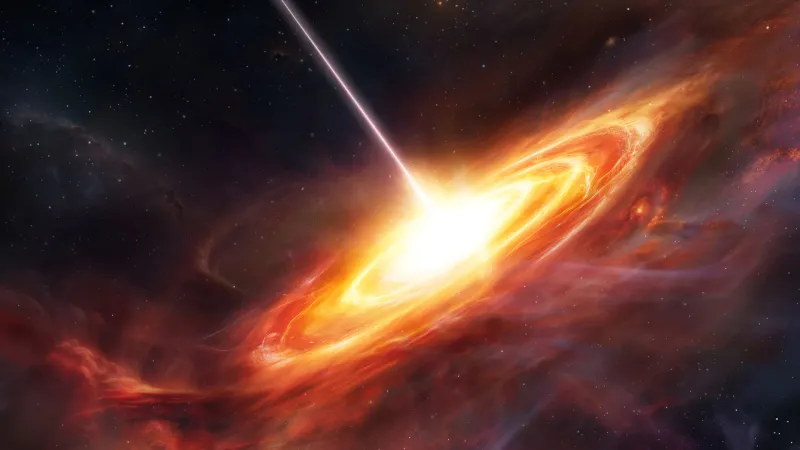
## Our Take: A Quasar’s Echo – Peering into the Dawn of Supermassive Black Holes The recent announcement from the Euclid space telescope, revealing the most distant quasar observed to date, represents a significant leap forward in our understanding of the early universe. This discovery, detailed in preliminary reports, allows us to peer further back in time than previously possible, offering a unique window into the conditions that fostered the rapid growth of supermassive black holes (SMBHs) in the cosmos. Quasars, as we know, are incredibly luminous active galactic nuclei powered by SMBHs accreting matter – essentially, black holes consuming vast quantities of gas and dust. Identifying one at such a vast distance, meaning we are observing it as it existed just 500 million years after the Big Bang, immediately challenges existing models of galactic and black hole evolution. The sheer existence of such a behemoth so early poses a fundamental question: how did these objects reach such immense sizes so quickly, given the relatively short timeframe available? Exploring the early universe in this way is crucial; for example, recent findings on the James Webb Space Telescope have also surprised researchers with the abundance of early galaxies JWST Early Galaxies. This Euclid discovery complements these observations, offering a different, but equally valuable, piece of the puzzle. The significance of this quasar finding extends beyond a simple record-breaking observation. It provides empirical data that can be used to test and refine our cosmological models. Current theories struggle to explain how SMBHs could accumulate the necessary mass in such a comparatively brief period. One hypothesis suggests that they formed from the direct collapse of massive gas clouds, bypassing the typical stellar evolution pathway. Another proposes that smaller "seed" black holes, perhaps formed from the remnants of early, massive stars, rapidly merged and accreted matter. The Euclid data, coupled with observations from other powerful telescopes such as the James Webb Space Telescope, will allow researchers to calibrate these models with unprecedented precision. For instance, further study of the quasar’s host galaxy – its morphology, star formation rate, and gas content – will provide crucial insights into the environment that facilitated the black hole's growth. The integrated data ecosystem we’re building through these observations is allowing us to approach these questions with a level of detail previously unimaginable. Understanding the connection between SMBH growth and galaxy evolution is a central goal of modern astrophysics, and this discovery provides a powerful new tool for advancing that understanding. More detailed information about Euclid's capabilities can be found Euclid Mission Overview. The implications for our broader understanding of the universe are profound. The early growth of SMBHs likely played a pivotal role in shaping the evolution of galaxies, influencing their star formation rates and overall structure. These black holes can launch powerful jets of energy that heat and expel gas, effectively stifling star formation in their host galaxies. Understanding how this process unfolded in the early universe is crucial for explaining the distribution of galaxies we observe today. Furthermore, the discovery highlights the remarkable capabilities of the Euclid space telescope, designed to map the geometry of the dark universe and study the evolution of cosmic structures. Its wide-field view and high sensitivity are proving invaluable for uncovering faint, distant objects like this quasar, pushing the boundaries of our observational reach. The ability to observe these extreme objects in real-time, as near as possible to their formation, provides a validation of our observational techniques and inspires confidence in future discoveries. Looking ahead, a crucial question arises: how common were these rapidly growing SMBHs in the early universe? Will further Euclid observations reveal a population of similarly distant quasars, suggesting that such rapid growth was more prevalent than currently believed? More detailed spectroscopic analysis of this quasar’s light will also be essential. By examining the absorption lines imprinted on the light as it travels through intervening gas clouds, we can probe the composition and density of the intergalactic medium, providing further constraints on the conditions in the early universe. The data gathered will undoubtedly fuel intense debate and lead to new theoretical frameworks, pushing the boundaries of our knowledge and prompting a re-evaluation of our understanding of the cosmos.
Read on the original site
Open the publisher's page for the full experience